

Drive DeVilbiss Scooter Review for UK Buyers
A mobility scooter has to fit into real life, not simply look suitable on a product page. This Drive DeVilbiss scooter review looks at what the brand tends to do well, where the compromises can be, and how to decide whether one is right for your journeys, home and car.
Drive DeVilbiss is a familiar name in UK mobility equipment. Its scooter range covers several everyday needs, from compact models designed to come apart for car transport to larger pavement and road-capable scooters for people who want to travel further in comfort. That breadth is useful, but it also means that there is no single ‘best’ Drive DeVilbiss scooter. The right choice depends on where you will use it most.
Drive DeVilbiss scooter review: the overall picture
The strongest point of the range is its practical focus. Many Drive DeVilbiss scooters are designed around the situations that cause the most difficulty for customers: getting to local shops, keeping up with family on an outing, moving around a holiday park, or avoiding the exhaustion and pain of a longer walk.
Across the range, the controls are generally straightforward, with familiar tiller steering, a clear speed dial and easy-to-reach levers. This can make the brand a reassuring option for first-time scooter users and for relatives buying on someone else’s behalf. A scooter should not feel intimidating before it has even left the driveway.
Comfort is another reason people consider Drive DeVilbiss. Larger models commonly offer a supportive swivel seat, adjustable armrests and more room around the footwell than a compact boot scooter. These details matter when a person has arthritis, reduced balance, hip pain or limited stamina. Being able to turn the seat before standing can make getting on and off feel considerably safer.
That said, comfort, range and portability rarely come together without compromise. A small scooter is easier to lift or store, but is less suited to rough ground and longer distances. A bigger model may feel more stable and have a more generous seat, yet it can be difficult to transport without a vehicle lift, ramp or suitable storage space.
Choosing the right type for your routine
Travel and car-boot scooters
For short local trips and days out, a dismantling scooter is often the most practical starting point. These models usually separate into manageable sections for the boot of a car, allowing a user or carer to take the scooter to town, the coast or family visits.
The word ‘manageable’ deserves some care. Even when a scooter comes apart, its heaviest section may still be too heavy for some people to lift safely. If you have back problems, a smaller build, or will be loading the scooter alone, check the individual component weights rather than relying only on the overall scooter weight. A folding scooter can save time, but it too must be lifted into the car unless you use a ramp or hoist.
Compact Drive DeVilbiss scooters are best viewed as transport-friendly companions, rather than all-day outdoor machines. They are a good fit for smooth pavements, supermarkets, shopping centres and indoor spaces. They can feel less composed on uneven paths, gravel and dropped kerbs, especially if the user is tall, needs a wider seat or carries shopping.
Pavement scooters for everyday independence
A mid-sized pavement scooter is often the best balance for people who mainly travel around their neighbourhood. It may offer better suspension, larger wheels and a more comfortable seat than a boot model, without becoming as large as a road scooter.
This category suits someone who wants regular independence but does not need to travel at road speed. It can be a sensible choice for trips to nearby shops, appointments, friends’ homes and accessible parks. Before ordering, measure the narrowest doorway, hallway turn and storage area at home. A scooter that is ideal outdoors is of limited use if it cannot be parked or charged safely indoors.
Also consider the route, not just the distance. A mile of smooth level pavement uses far less battery than a mile involving slopes, uneven surfaces, frequent stops and cold weather. Manufacturer ranges are useful comparisons, but they should be treated as a guide rather than a promise for every journey.
Larger road-capable scooters
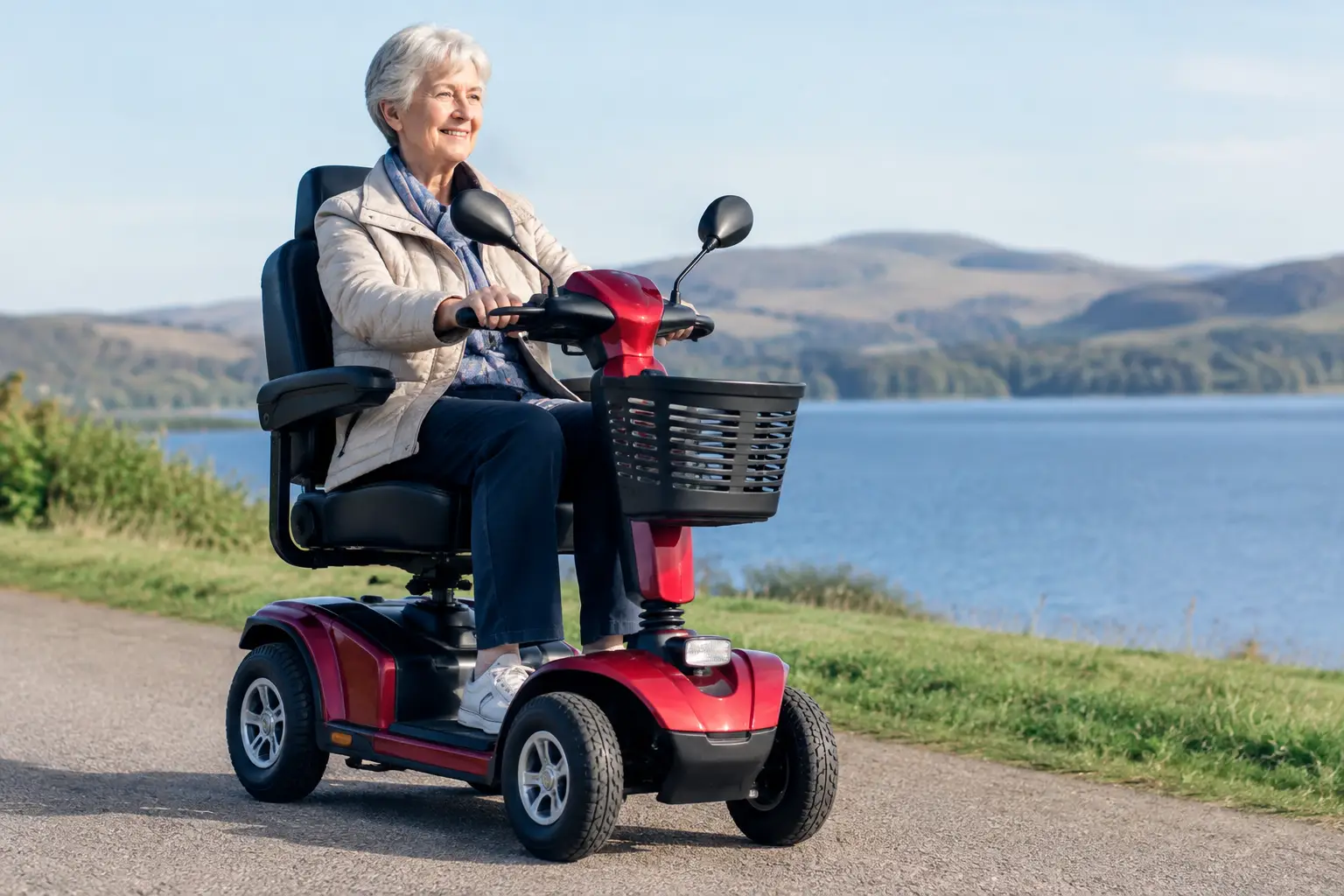
For customers living in villages, on the edge of town or some distance from regular facilities, a larger Class 3 scooter can make a meaningful difference. These machines are typically built for longer journeys, greater comfort and stronger outdoor performance. They are usually more stable on uneven ground and may include lighting, indicators, mirrors and a higher maximum speed for road use where permitted.
The trade-off is size. A road-capable scooter needs secure storage and a reliable charging point. It may not fit through a standard domestic doorway, and it is unlikely to be a practical option for a small car boot. It is also worth learning the rules around Class 3 use, including registration requirements and where the scooter may be driven. A larger scooter brings greater freedom, but it should be chosen with a clear plan for parking, charging and safe local routes.
What to check before buying
A Drive DeVilbiss scooter can be dependable and comfortable when its specification matches the user, but a few checks prevent the most common disappointments. Start with the user’s weight and allow for coats, bags or shopping. Never choose a scooter that is only just within its maximum user-weight limit. Having a sensible margin supports comfort and performance.
Seat dimensions matter as much as weight capacity. Look at seat width, depth, back support and armrest adjustment. A person who sits slightly forward because the seat is too narrow or shallow may tire quickly, even on a well-made scooter. If standing and transferring are difficult, a swivel seat and lift-up armrests are especially useful features.
Think honestly about terrain. Thick grass, loose gravel, steep ramps and deeply uneven paving are demanding for any scooter, particularly smaller models. If these surfaces are part of daily life, prioritise wheel size, ground clearance, suspension and stability over a low overall weight. A compact scooter may still be the right choice for occasional travel, but it is not automatically the safest choice for country lanes or rough paths.
Battery care should be part of the decision too. Scooters need regular charging, even when they are not used every day. Choose a dry, accessible place with a mains socket, and avoid leaving batteries to run completely flat. Cold weather can reduce available range, so allow more charge than usual for winter trips. If a scooter has been stored for a while, checking the batteries and charger before relying on it is sensible.
Are Drive DeVilbiss scooters good value?
Value is not simply the purchase price. A lower-priced compact scooter can be excellent value for a person who needs occasional help around shops and family outings. It becomes poor value if it is bought for hills and long outdoor journeys that require a larger, more capable model.
Drive DeVilbiss is worth considering because the range gives buyers options at different sizes and use levels. Availability of replacement parts, batteries and servicing support also matters over time. Mobility equipment is a long-term purchase, and being able to ask for practical help after delivery is as valuable as an attractive initial price.
At Mobility Scooters UK Ltd, the best starting point is a conversation about the user’s normal week: where they want to go, whether a car is involved, the surfaces they meet and what help is available with lifting or charging. Those answers narrow the choice far more effectively than choosing by colour or top speed alone.
Who is likely to be happiest with one?
Drive DeVilbiss scooters can suit first-time users who want uncomplicated controls, experienced owners replacing an older machine, and carers seeking a recognised mobility brand with practical options. They are particularly worth considering when you can identify a clear use case, whether that is car-boot travel, local pavement journeys or longer independent outings.
They may be less suitable if your priority is specialist off-road use, very tight indoor spaces, or lifting a scooter without assistance. In those cases, another scooter style, a powered wheelchair or a ramp and vehicle solution may offer a better day-to-day result.
The most helpful purchase is the one that makes tomorrow’s journey feel possible. Measure the spaces, picture the route and choose the scooter that supports the life you want to keep living.