Can Scooters Go on Buses? UK Rules Explained
A bus journey can make the difference between staying at home and getting to the shops, a medical appointment or seeing family. But can scooters go on buses? In the UK, the answer is sometimes – not automatically. Whether you can travel depends on your scooter, the bus operator’s policy, the route and whether you have completed its mobility scooter assessment or permit scheme.
That uncertainty can feel frustrating, particularly when a scooter gives you the confidence to travel independently. The good news is that many operators do welcome suitable mobility scooters on accessible buses. Planning ahead is the key to avoiding a wasted journey or an awkward situation at the bus stop.
Can mobility scooters go on buses in the UK?
Many local bus companies allow certain mobility scooters to travel in the wheelchair space, provided they meet the operator’s conditions. These conditions are usually based on an industry guidance scheme and are designed to ensure the scooter can turn safely, fit within the space and remain stable during the journey.
However, there is no single rule that covers every bus company in every part of the UK. One operator may accept an approved Class 2 scooter with a permit, while another may not carry mobility scooters at all. London buses have their own arrangements, and policies can differ between city, rural and community services.
Most operators that do accept scooters will only carry one at a time because the wheelchair bay is a shared, designated space. A wheelchair user generally has priority for that space. If it is already occupied, you may need to wait for the next bus, even if your scooter is approved.
Why bus operators set limits
The limits are about safety rather than excluding scooter users. Bus aisles, turning areas and wheelchair bays have fixed dimensions. A larger pavement or road scooter may be comfortable outdoors but may be unable to manoeuvre through the entrance or turn into position without blocking the gangway.
Weight matters too. The combined weight of the scooter, batteries, shopping and passenger must be suitable for the bus ramp and wheelchair area. Bus drivers also need to be able to secure the space correctly and make sure the scooter will not move when the vehicle brakes, turns or pulls away.
For this reason, a scooter that folds or comes apart is not automatically suitable for travel in its assembled form. A compact travel scooter may be a good candidate, but the operator must still confirm it meets its policy.
Class 2 and Class 3 scooters
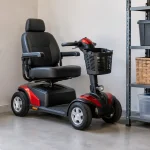
A Class 2 mobility scooter has a maximum speed of 4 mph and is designed for pavements and pedestrian areas. These are the models most commonly considered for bus travel, particularly compact, lightweight and travel-friendly designs.
Class 3 scooters can travel at up to 8 mph on the road and are often larger, heavier and longer. They are excellent for longer outdoor journeys when suitable for the user’s needs, but many bus operators will not allow them on board. Do not assume that switching the speed down to 4 mph changes its eligibility.
The exact dimensions and weight limits vary, so the scooter’s class alone is never a guarantee. Always check the operator’s current requirements before choosing a scooter specifically for bus journeys.
The mobility scooter permit process
Where scooters are accepted, many bus companies operate a permit scheme. It may be called a mobility scooter permit, scooter card, travel pass or safe travel assessment. The process is normally straightforward and is there to give both you and the driver confidence.
You may be asked to take your scooter to a depot, travel centre or arranged assessment point. A trained member of staff will check that it fits the relevant size and weight limits. They may also ask you to demonstrate that you can drive slowly, use the controls safely, turn into the wheelchair bay and position the scooter correctly.
If approved, you will usually receive a permit or card to carry when travelling. Some operators may place a sticker on the scooter. Keep it with you, as a driver may need to see it before allowing you to board.
An assessment is not a test of your independence. It is a practical check that the particular scooter and user can travel safely on that operator’s buses. It can also be useful practice if you are new to using ramps and confined turning spaces.
What to check before you travel
Before setting out, contact the bus company that runs your intended route. Ask whether it accepts mobility scooters, whether a permit is required, and whether your particular make and model is likely to qualify. Give them the scooter’s width, length and total weight where possible, including batteries.
It is also worth checking the route rather than relying on a general policy. Some services use different vehicles at different times, and older or smaller buses may have different access arrangements. Community transport, coaches and replacement buses may have separate rules.
Make sure your battery is adequately charged, especially if the journey includes several stops or a return trip. Carry your permit, any essential medication, your mobile phone and a payment method or concessionary pass somewhere easy to reach. Avoid hanging heavy bags from the handlebars, as they can affect steering and stability.
If you are travelling for the first time, choose a quieter time of day if you can. This gives you and the driver more space to manage boarding without feeling rushed.
Boarding and travelling safely on your scooter
Wait where the driver can see you clearly and signal as you would for any bus. The driver will usually lower the bus or extend a ramp. Follow their instructions, as the layout of the bus and the safest boarding method can vary.
Drive on slowly and steadily. Keep your speed to walking pace, look ahead rather than at the controls, and take care on the ramp in wet weather. Once inside, position the scooter in the wheelchair bay as directed. Usually, this means facing towards the rear of the bus, with the back of the scooter against the backrest or safety pad, but follow the driver’s instructions and the signs on the vehicle.
Switch off the scooter and remove the key if appropriate. Some operators ask passengers to apply the parking brake or use a fitted restraint. Do not remain on the scooter if the operator’s policy says you must transfer to a seat, although many scooter schemes are designed for users to stay seated in their scooter. Your assessment or permit information should make this clear.
When it is time to get off, give the driver plenty of notice. Wait until the bus has stopped fully and the ramp is in place before moving. Take the descent slowly, keeping the scooter straight and under control.
Choosing a scooter with bus travel in mind
If regular bus travel is part of your routine, portability is worth considering alongside comfort, range and suspension. A compact Class 2 scooter with a tight turning circle can make daily transport much easier than a larger model, even if the larger model offers more outdoor capability.
That said, the smallest scooter is not always the right choice. You may need a supportive seat, higher weight capacity, longer battery range or better ground clearance for the journeys you make once you leave the bus. The right decision balances bus compatibility with your comfort and safety every day.
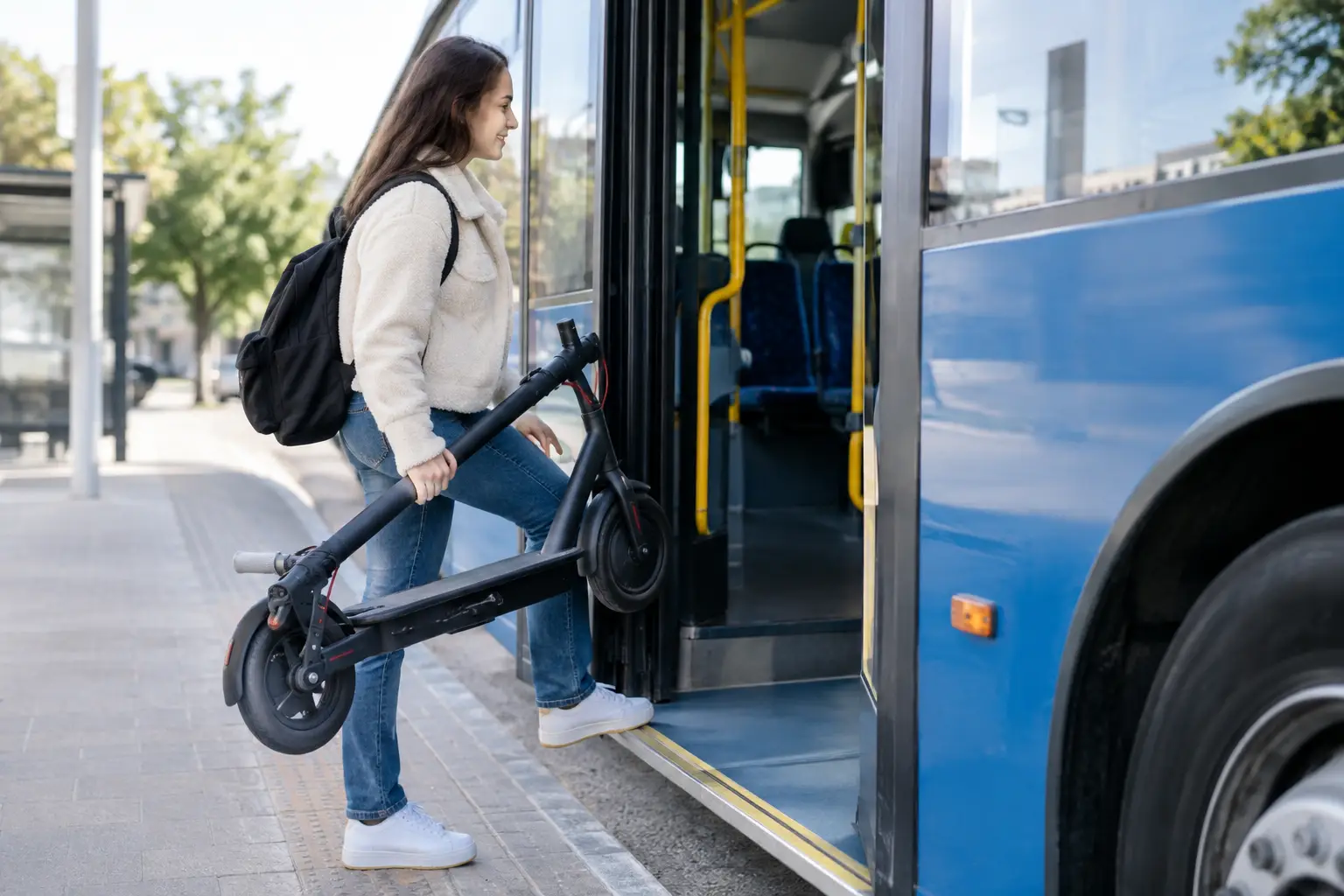
Folding scooters and car-boot scooters can be particularly useful for mixed travel. If an operator does not permit your scooter in the wheelchair bay, a genuinely lightweight folding model may sometimes be carried folded as luggage, but only if the bus company allows it and it can be handled safely. Never expect a driver to lift a heavy scooter or battery for you.
At Mobility Scooters UK Ltd, practical advice starts with how you plan to live and travel, not simply the speed or appearance of a model. For bus users, checking the published dimensions, weight and manoeuvrability before purchase can prevent an expensive mismatch.
If your scooter is not allowed on the bus
Being refused travel does not mean your options are over. Ask the operator why the scooter was unsuitable. It may be too large, above the permitted weight, outside its approved model list or simply not covered by that service’s policy.
You could explore accessible taxis, community transport, rail assistance, a folding scooter for selected journeys or a different local route. If you are replacing a scooter, this information can help you choose a more transport-friendly model without sacrificing the features you genuinely need.
A little preparation gives you the best chance of making bus travel part of your normal routine. Check the local policy, arrange an assessment where needed, and choose equipment that supports both your independence and the journeys you want to make.