

Road Legal Mobility Scooters UK Explained
A trip to the local shops, an appointment across town or a visit to friends should not have to depend on whether someone can manage a long walk. Road legal mobility scooters UK buyers choose can make those everyday journeys more achievable, but it is essential to select the right type of scooter and understand where it can be used.
A road-capable scooter is not simply a faster pavement scooter. It is usually a Class 3 mobility scooter, designed with the lighting, controls and stability needed for use on public roads as well as pavements. For many people, that added flexibility brings welcome independence. For others, a lighter car-boot or folding model may be the more practical choice. The best option depends on where, how far and how often the scooter will be used.
What makes a mobility scooter road legal in the UK?
Mobility scooters are generally grouped into two main categories. Class 2 scooters are intended for pavement use and have a maximum speed of 4 mph. They are often compact, lightweight or designed to come apart for transport in a car.
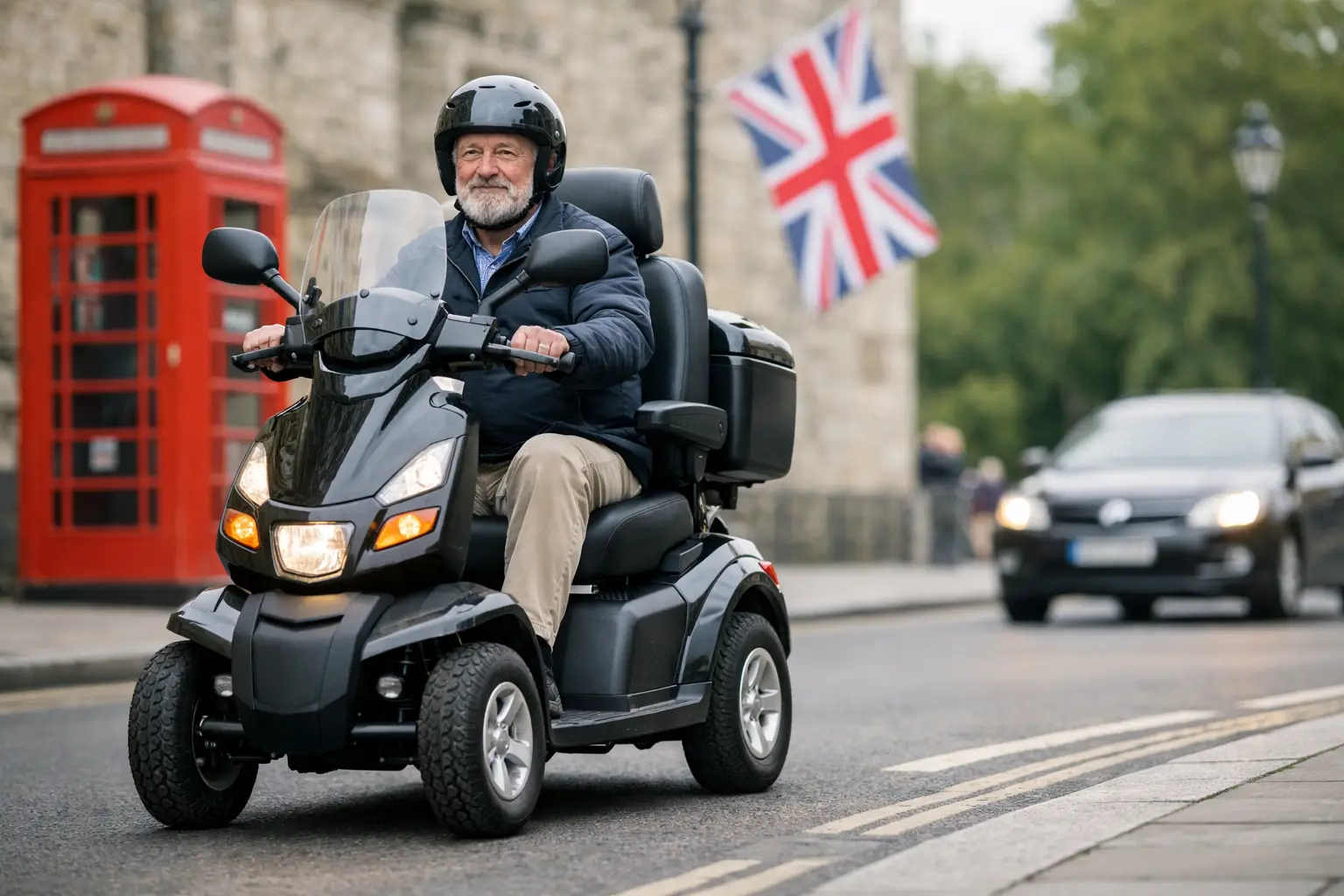
Class 3 scooters are the road legal mobility scooters UK customers usually mean when they ask about travelling on roads. They can travel at up to 8 mph on the road, although they must be limited to 4 mph when used on pavements and other pedestrian areas. This speed change is an essential safety feature, not an optional extra.
To be used legally on the road, a Class 3 scooter must meet the required specification. That includes a maximum speed of 8 mph, an efficient braking system, a rear-view mirror, horn, front and rear lights, rear reflectors, direction indicators and hazard warning lights. It should also display its maximum speed in miles per hour.
These features help other road users see the scooter and understand its movements, particularly in poor weather, at dusk or on a busy local road. They also make a considerable difference to the rider’s confidence when joining traffic.
Registration is required, but tax is not
A Class 3 scooter must be registered with the DVLA. There is no charge for registration, and the scooter does not need vehicle tax, an MOT or a driving licence. The process is straightforward, but it should be completed before regular road use.
The rider must be at least 14 years old and have difficulty walking due to an injury, physical disability or medical condition. A person may also use a scooter while acting for someone who meets these conditions. If you are buying for a parent, partner or person you care for, it is sensible to make sure the registered user understands the basic controls and feels comfortable operating the scooter.
Where can a Class 3 scooter be used?
A Class 3 scooter can be used on roads where it is safe and permitted, as well as on pavements, footpaths and pedestrian areas at the lower 4 mph setting. However, road use comes with clear restrictions.
Mobility scooters must not be used on motorways, in bus lanes or in cycle-only lanes. They should not be used in areas marked for cyclists only. On dual carriageways, a Class 3 scooter can only be used if it has an active flashing amber beacon. Even where it is legal, a dual carriageway can be intimidating and unsuitable for many riders, so a quieter alternative route is often the wiser choice.
On the pavement, pedestrians always come first. Keep to 4 mph, give people plenty of room and take particular care around children, dogs, shop entrances, bus stops and blind corners. A mobility scooter is there to support independence, not to make others move out of the way.
Road conditions matter too. Potholes, steep cambers, narrow lanes, fast-moving traffic and poorly dropped kerbs can make a route difficult, regardless of the scooter’s legal classification. Before committing to a longer journey, try the route at a quieter time or travel with a friend or carer until it feels familiar.
Choosing a road-capable scooter for your routine
The most suitable scooter is rarely the one with the highest top speed. A road-capable model should suit the journeys you genuinely want to make, while providing comfortable, secure support throughout the day.
Start with range. Consider the full return journey, rather than the distance one way. Battery range can be affected by the user’s weight, hills, cold weather, tyre condition and repeated stopping and starting. It is reassuring to have spare capacity rather than arriving home with a nearly empty battery.
Comfort deserves equal attention. For longer outings, a supportive adjustable seat, armrests, suspension and a clear driving position can reduce fatigue. Larger wheels and better ground clearance can make uneven pavements, dropped kerbs and rougher paths feel more manageable. If the scooter will mainly be used around smooth town-centre routes, a more compact model may be easier to park and manoeuvre.
Storage and transport are often the deciding factors. A substantial Class 3 scooter is ideal for independent journeys from home, but it may not fit into a standard car boot or be easy to store in a narrow hallway. Measure gates, doorways, shed access and the available charging space before ordering. If you need to take a scooter on family outings, a folding or car-boot model may be more useful, though these are typically Class 2 rather than road legal.
There is also a difference between road-capable and all-terrain. A sturdy road scooter can handle ordinary outdoor surfaces and local routes, but it is not automatically suitable for deep gravel, muddy tracks or very steep ground. For rural use or frequent uneven terrain, look for suitable tyres, suspension, a stable wheelbase and enough ground clearance. Honest advice about your usual environment is more valuable than paying for features you will never use.
Safe use starts before the first journey
A new scooter takes a little getting used to. Begin in a quiet, open area and practise moving off, stopping, reversing, turning and adjusting the speed control. Learn how wide the scooter turns and how it behaves on gentle slopes before heading onto a public pavement or road.
Use the lights when visibility is reduced, indicate clearly and allow more time than you think you need at junctions. Avoid sharp turns at speed, especially on sloping ground, and keep bags or shopping secure so they cannot interfere with the controls. Do not overload the basket or exceed the scooter’s stated user weight and carrying limits.
Battery care is part of dependable ownership. Charge the battery as instructed, preferably in a dry, ventilated area using the correct charger. Leaving a scooter unused for long periods without maintaining the battery can reduce its performance. Tyres, brakes, lights and steering should also be checked regularly, with servicing arranged when needed.
Insurance is not a legal requirement for most mobility scooter users, but it is worth considering. Cover may help with accidental damage, theft, public liability and recovery if the scooter breaks down away from home. It can offer useful reassurance for anyone planning regular road journeys.
Questions to ask before you buy
Before choosing a Class 3 scooter, think through the practical details: Can it be stored and charged safely at home? Is the route to the shops suitable? Will the seat remain comfortable after an hour? Can the user reach the controls easily and see clearly around the scooter? Is there local after-sales help available for batteries, servicing and replacement parts?
For a significant purchase, friendly specialist guidance can prevent an expensive mismatch. Mobility Scooters UK Ltd offers a range of recognised mobility brands and can help customers compare road-capable scooters around their comfort, range, storage and everyday travel needs.
The right scooter should make the world feel more accessible, not more complicated. Choose a model that fits the journeys you want to make, practise using it safely and enjoy the confidence that comes from getting out on your own terms.