

How to Choose a Powerchair for Everyday Life
A powerchair should make the ordinary parts of the day feel possible again: getting to the kitchen without exhaustion, joining family in the garden, visiting the shops or keeping up on a day out. The best choice is rarely the model with the highest speed or longest range. It is the chair that fits your body, your home and the places you genuinely want to go.
If you are wondering how to choose a powerchair, begin with your routine rather than a specification sheet. Think about where you will use it most, how long you sit each day, whether it needs to travel in a car and how much support you need to transfer, position yourself and stay comfortable.
Start with where the powerchair will be used
A powerchair designed mainly for indoor use is very different from one intended for daily trips around town. Indoor and compact models are often easier to turn in a hallway, move around furniture and position at a table. Their smaller footprint can be a real advantage in a flat, bungalow or older house with narrow doorways.
For regular outdoor use, look for a chair with suitable wheels, suspension where needed, a supportive seat and a battery range that leaves room for the unexpected. Pavements with dropped kerbs, uneven paths and changes in surface can quickly show up the limitations of a very lightweight indoor chair.
It is worth being honest about your usual routes. A chair that manages smooth supermarket floors may not be right for a rough estate path, a sloping driveway or a local park. Equally, a larger outdoor powerchair may offer excellent comfort but be impractical if it cannot get through your front door or turn into the bathroom.
Before choosing, measure the narrowest internal doorways, key turning spaces and the area where the chair will be stored and charged. Include skirting boards, radiators and furniture in your measurements. If ramps, thresholds or a lift are involved, check these too. A few careful measurements can prevent an expensive and frustrating mismatch.
Choose a seating position that works for your body
Comfort is not an optional extra when a powerchair will be used every day. A seat that feels acceptable for ten minutes can become uncomfortable after an hour. Consider seat width, depth, back support, armrest height, footplate position and the type of cushion supplied.
The right seat width gives support without pinching at the hips or leaving too much space at either side. Seat depth matters too: the user should be supported along the thighs without the front edge pressing behind the knees. Footplates should allow the feet to rest securely, not dangle or force the knees too high.
Some people will benefit from adjustable features such as reclining backs, tilt functions, elevating leg rests or powered seat elevation. These can improve pressure relief, posture, transfers and everyday reach. They also add weight, complexity and cost, so choose them because they meet a clear need, not simply because they sound useful.
If the user has changes in posture, pain, pressure-area concerns, limited trunk control or needs significant assistance with transfers, seek advice from an occupational therapist or seating specialist before buying. A powerchair is a meaningful investment in independence, but it also needs to provide safe support throughout the day.
Decide how portable the chair needs to be
For many families, transport is the deciding factor. If the powerchair needs to come with you in a car, do not assume that “folding” means it will be easy to lift. Check the chair’s total weight, whether the battery can be removed, whether it folds or dismantles, and the heaviest part that must be handled.
A lightweight folding powerchair can be a practical option for occasional outings, holidays and cars with limited boot space. The trade-off may be a smaller seat, less suspension, a shorter range or reduced performance on uneven ground. For someone who uses their chair for several hours every day, a more substantial model may be more comfortable and dependable even if it is less convenient to transport.
Also consider who will load it. A chair that is manageable for a fit relative may not be safe for an older partner or carer to lift repeatedly. In some cases, a vehicle hoist, wheelchair-accessible vehicle or a chair kept mainly at home is a more realistic solution.
Look beyond the advertised battery range
Battery range is useful as a guide, but it is not a guarantee of how far you will travel in all conditions. User weight, hills, grass, cold weather, tyre pressure, frequent stopping and battery age can all reduce the distance available from a charge.
Choose a range that comfortably exceeds a normal day out rather than aiming for the minimum. If a typical trip involves travelling to the high street, visiting appointments and returning home, leave a sensible margin. Charging every night is often a simple routine for regular users, but batteries should be charged and maintained as advised for the specific chair.
Think about where charging will happen. You need a dry, accessible place near a suitable socket, with enough room to park the chair safely. Avoid creating a situation where the only charging point blocks an escape route or leaves cables across a walkway.
Control, manoeuvrability and confidence matter
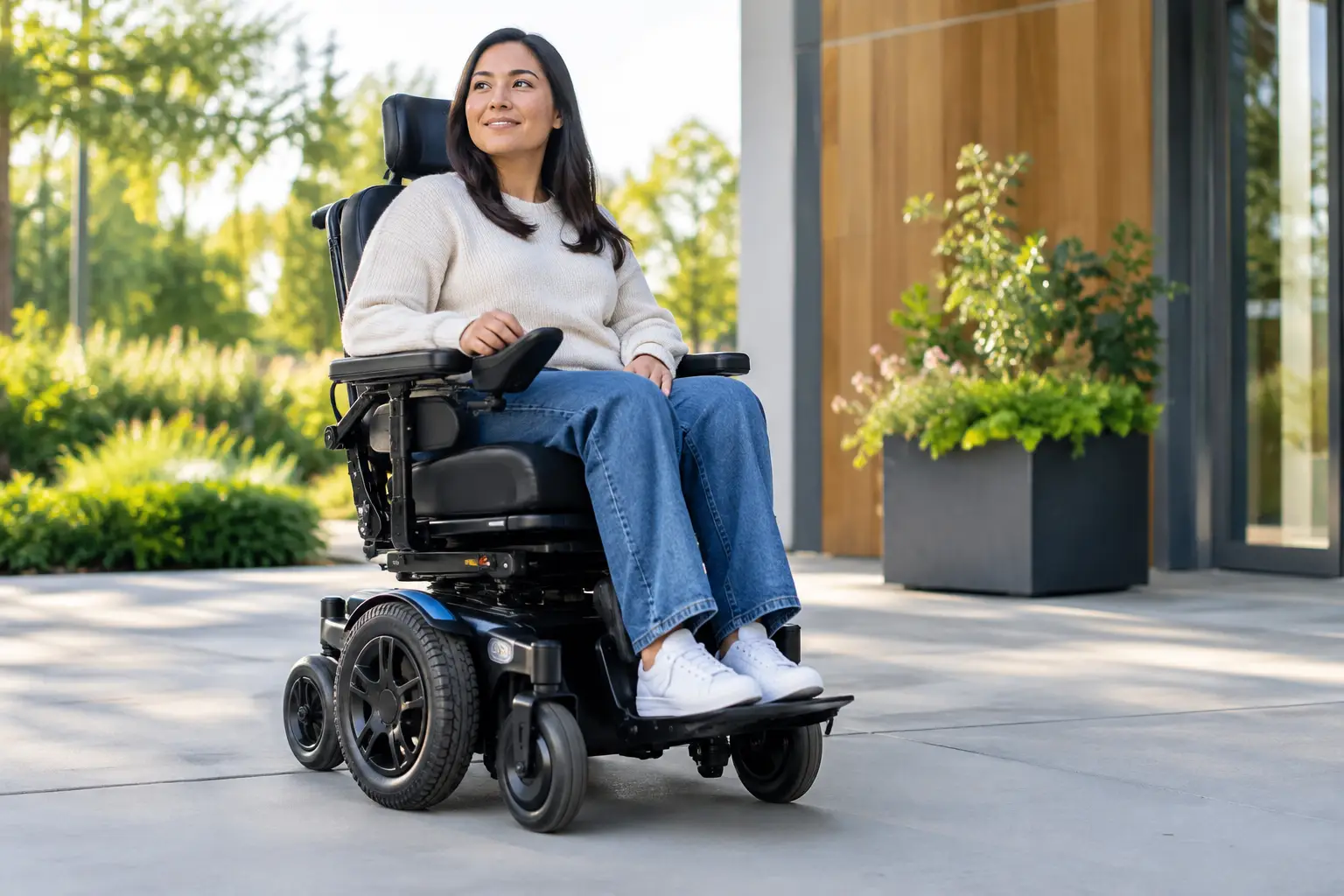
Most powerchairs use a joystick control, normally fitted to one armrest. Check that it can be placed on the side the user can operate most comfortably. Joystick sensitivity, hand strength, finger control and reaction time all matter. A simple test drive can reveal more than a photograph or a list of features.
Turning circle is particularly important indoors. Mid-wheel drive powerchairs are often very manoeuvrable in tight spaces and can feel intuitive around the home. Front-wheel and rear-wheel drive designs may suit different outdoor conditions and driving preferences. There is no single best layout: the practical answer depends on your home, confidence level and usual terrain.
Look for features that support safe everyday use, including a stable seating position, anti-tip wheels, a clear battery display, effective brakes and suitable lighting or indicators where required. If the chair will be used on public routes, make sure it is appropriate for the intended speed and setting.
Understand pavement and road use before buying
Powered wheelchairs are commonly supplied in categories that affect where and how they can be used. Many chairs are intended for pavements and indoor areas, while road-capable models can travel at higher speeds and need the relevant equipment for use on the road.
A road-capable chair is not automatically the better choice. It may be larger, heavier and less convenient indoors. It should only be considered where the user genuinely needs to make longer outdoor journeys and can use it safely. Registration and legal requirements can apply to certain types of powered wheelchair, so check the current rules and the chair’s classification before placing an order.
Even on a pavement, drive with care around pedestrians, kerbs, crossings and poor surfaces. A powerchair gives freedom, but it should feel calm and controlled rather than intimidating to use.
Check the practical details carers often spot first
Small details can have a large effect on day-to-day use. Can the user get close enough to the kitchen worktop or dining table? Will the armrests lift or remove for side transfers? Is there space for a bag, walking stick, oxygen equipment or essentials? Can the footplates be moved aside safely when getting in and out?
Ask about the chair’s maximum user weight, including clothing and any items regularly carried. Choosing the correct capacity protects comfort, stability and the long-term performance of the chair. Bariatric powerchairs can provide a wider, stronger and more supportive option where standard seating is not suitable.
Think ahead about servicing, replacement batteries, tyres and repairs too. A recognised model backed by available parts and knowledgeable UK support can be more reassuring than a bargain chair with uncertain aftercare. Mobility Scooters UK Ltd can help customers compare established brands and practical features, particularly when the choice comes down to portability versus all-day comfort.
How to choose a powerchair with confidence
The most useful question is not “Which powerchair is best?” but “Which one will make this person’s normal week easier?” Write down the rooms, routes, transfers and journeys that matter most. Then match the chair to those real tasks, allowing for comfort, charging, storage and support over time.
If possible, arrange a demonstration or speak to a mobility specialist with your measurements and requirements ready. A good conversation should leave you clearer, not pressured. The right powerchair can become a trusted part of daily life: one that supports independence while leaving more energy for the people and places that matter.