

Do Wheelchairs Fit Narrow Doors? Measure First
A wheelchair that feels ideal in a showroom can become frustrating if it catches on the bathroom door, cannot reach the kitchen, or needs awkward manoeuvring at every doorway. So, do wheelchairs fit narrow doors? Some do, but it depends on the chair’s overall width, the true clear opening of the doorway and how much turning space is available on either side.
For many people, door width is one of the most important checks to make before buying a wheelchair. A few minutes with a tape measure can prevent an expensive mismatch and help protect comfort, safety and independence at home.
Do wheelchairs fit narrow doors in UK homes?
Many older UK properties have internal doors that are narrower than modern accessible layouts. A nominal 30-inch door, for example, may sound generous, but the usable opening can be noticeably smaller once the door is open, particularly where hinges project into the gap.
As a broad guide, internal door leaves are often around 686mm, 762mm or 838mm wide. The opening available to pass through is not necessarily the same as the door leaf measurement. A wheelchair must clear the frame, door edge and hinges, ideally without scraping hands, tyres or armrests.
A compact transit wheelchair may have an overall width of roughly 550mm to 650mm. Many self-propelled wheelchairs are wider because the large rear wheels sit outside the seat, often bringing the overall width to around 630mm to 700mm. Powerchairs, bariatric wheelchairs and chairs with wider seating can require even more space.
This means a chair may pass through one narrow doorway but not another. Bathroom and cloakroom doors are especially likely to cause problems, as they can be narrow and may have little room for turning once you are inside.
Measure the clear opening, not just the door
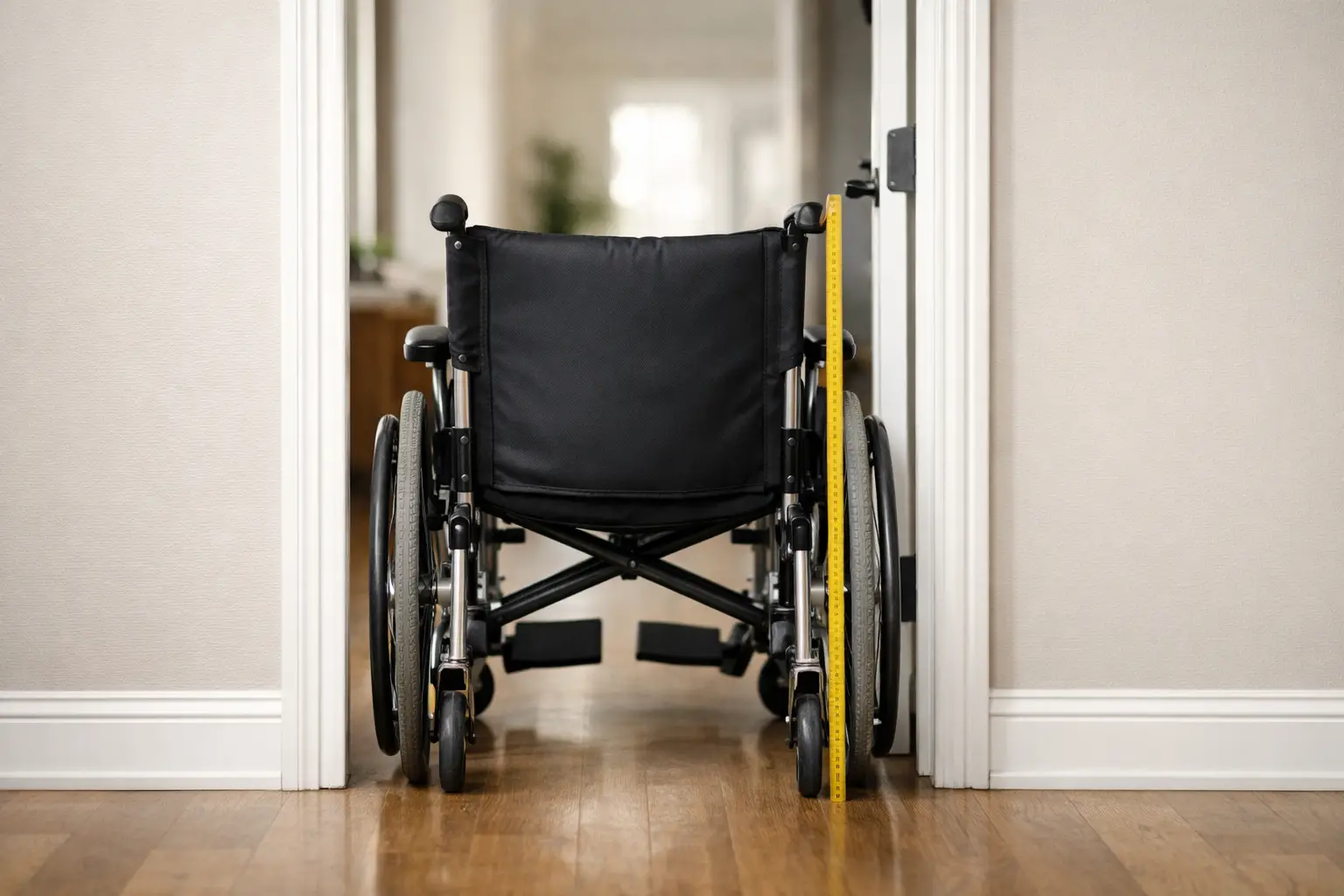
The most useful measurement is the clear opening: the narrowest usable gap when the door is fully open. Open the door as far as it will go, then measure from the face of the open door or hinge side to the opposite door frame. Measure at floor level, where tyres and footplates need to pass.
Take the measurement in millimetres and write it down. It is also worth measuring at more than one height if the frame is uneven or has fitted trim. If there is a radiator, handrail or furniture close to the doorway, include that in your assessment too.
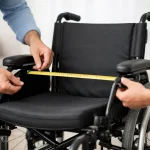
Next, check the wheelchair specification for its overall width. Do not rely on seat width alone. A 460mm seat wheelchair can be far wider across the wheels, handrims or armrests. For a powered chair, allow for any joystick controls and consider whether the chair can approach the doorway straight on.
A small amount of clearance may technically be enough, but it is rarely pleasant to use every day. Extra room makes a real difference if the user has limited arm strength, reduced hand control, pain, fatigue or impaired vision. It also gives carers more room to assist safely.
Remember the route through the doorway
Getting through a doorway is not only about its width. The user may need space to turn from a hallway, reverse out of a room or line up with the opening. A chair that fits neatly through a straight doorway can still be difficult to use where a tight corner comes immediately before or after it.
Check thresholds as well. Raised strips, uneven flooring and deep carpet edges can make the chair harder to push and increase the risk of catching a footplate or front castor. A small threshold ramp can sometimes improve access, but it needs to be correctly sized and stable for the wheelchair and user.
Which wheelchairs are better for narrow doorways?
If narrow doors are a key concern, compact dimensions should be part of the buying decision from the start. The right option depends on who will use the chair, how often it will be used and whether the user needs to propel themselves.
Transit wheelchairs are often a practical choice for indoor use where a family member or carer will usually push. Their smaller rear wheels can make them narrower and easier to guide through doorways, into cars and around shops. The trade-off is that they are not designed for independent self-propulsion over longer distances.
Lightweight self-propelled wheelchairs can offer a better balance where independence matters. However, the large wheels and handrims usually add width, so checking the exact model dimensions is essential. Folding chairs can be useful for storage and car transport, but folding does not automatically mean narrow when the chair is open and in use.
Narrow-seat wheelchairs are available for adults who are comfortably supported by a smaller seat. It is important not to choose a seat that is too tight simply to gain a few centimetres at the door. The user needs suitable hip room, support and space for clothing or cushions. An uncomfortable wheelchair can limit use just as much as an inaccessible doorway.
Powerchairs need particularly careful measuring. They offer valuable independence for people who cannot self-propel, but their turning circle, footplate length and overall width can make compact rooms challenging. Some compact indoor powerchairs are designed with tighter spaces in mind, yet every property and every user’s needs are different.
Practical ways to improve access at home
If a current wheelchair only just misses fitting, do not force it through. Repeated scraping can damage door frames and wheels, while squeezing hands through a tight gap risks painful knocks. There may be a practical solution, but it should be chosen safely.
For a removable internal door, taking it off temporarily can create a little more space in some homes. This may suit a room where privacy is not needed, but it is not appropriate for every household. Fire doors, entrance doors and doors in rented accommodation should not be altered without proper advice or permission.
Changing the hinges can sometimes allow a door to open wider. In other cases, a qualified joiner may be able to adjust or widen a doorway. This is a more permanent investment, but it can transform everyday access to a bathroom, bedroom or kitchen. If the doorway is part of a larger accessibility issue, an occupational therapist or home adaptation professional can help assess the safest layout.
Furniture placement can also make a surprising difference. Moving a side table, shoe rack or laundry basket away from a hallway corner may create the approach space needed to enter a room more comfortably. In bathrooms, think about whether there is enough room to close the door, transfer safely and leave again without reversing into fixtures.
A simple check before ordering a wheelchair
Before choosing a chair, measure every doorway the user needs to pass through regularly: the front entrance, bedroom, bathroom, kitchen and any route to a garden or parking area. Then compare the narrowest clear opening with the wheelchair’s stated overall width.
It is sensible to allow a comfortable margin rather than choosing a chair that fits only millimetre-perfectly. Consider the user’s clothing, winter layers, pressure cushions, shopping bags attached to the chair and whether a carer will need to walk alongside. If the wheelchair will be used mainly outdoors, its indoor doorway fit still matters because everyone needs to get home comfortably.
At Mobility Scooters UK Ltd, practical details such as chair width, portability and where the wheelchair will be used are central to finding a suitable option. A little planning before purchase can make daily routines easier from the first journey through the door.
The best wheelchair is not simply the narrowest one. It is the one that supports the user properly, suits their independence needs and fits the spaces that make up their everyday life.