

Can Mobility Scooters Climb Hills Safely?
Can mobility scooters climb hills? Many can, but the answer depends on the scooter, the steepness of the hill, the rider’s weight, battery condition and the surface under the tyres. A gentle rise to the local shops is very different from a long, wet hill with uneven paving. Choosing a scooter that suits your usual route can make everyday journeys feel more comfortable, safe and independent.
Can Mobility Scooters Climb Hills? It Depends on the Model
Mobility scooters are not all built for the same purpose. Compact travel and boot scooters are designed primarily for short pavement trips and easy transport in a car. They can usually manage modest inclines, particularly when the battery is well charged, but they may struggle on long or steep hills.
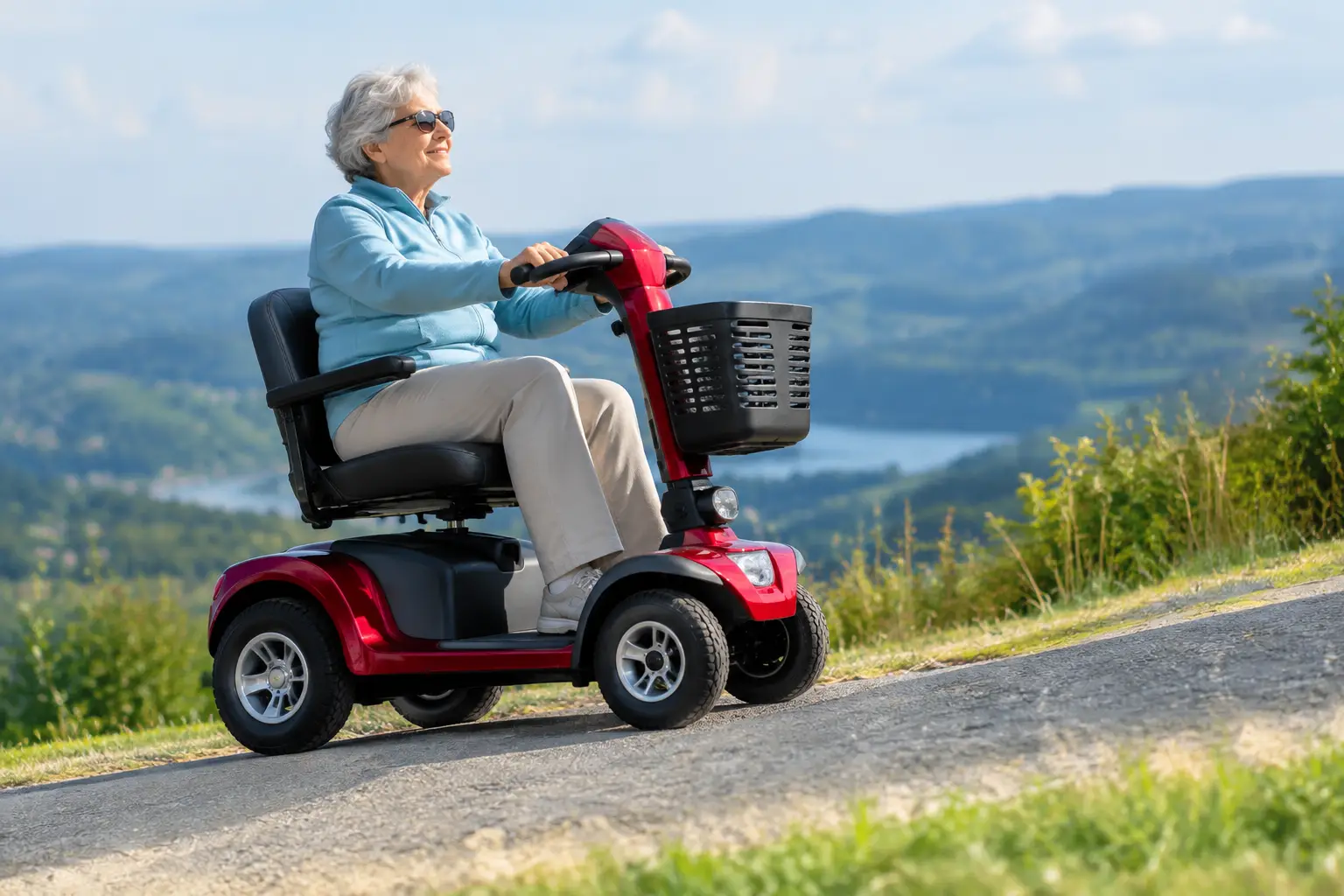
Larger pavement, road and all-terrain scooters generally have more powerful motors, larger batteries, stronger suspension and bigger wheels. These features can make a real difference on hills, uneven paths and outdoor routes. They are often the better choice for someone who lives in a hilly area, regularly visits parks, or needs to travel further from home.
Every scooter has a maximum safe gradient, usually shown in its user manual as degrees or a ratio. This figure is a safety limit, not a target to test. It is based on controlled conditions, so a hill that is technically within the stated limit may still be unsuitable if it is slippery, loose, badly surfaced or has a sharp bend.
A scooter’s class does not automatically tell you how well it will climb. Class 2 scooters are generally limited to 4 mph and intended for pavements, while Class 3 scooters can travel up to 8 mph on the road where permitted. Either type can vary greatly in power and hill ability, so it is always worth comparing the individual model rather than relying on the class alone.
What Makes a Hill Difficult for a Mobility Scooter?
The gradient matters most. A short, gentle incline can be manageable for many scooters. A longer hill places greater demand on the motor and battery, even if it does not look especially steep. Starting halfway up a hill is often harder than approaching it with steady momentum from level ground.
Rider weight and what you carry also affect performance. The stated maximum user weight must include any shopping, walking aids, oxygen equipment or other belongings kept in the basket or storage area. Staying within the limit helps the scooter brake, steer and climb as intended.
Battery health is another major factor. A battery that appears to have enough charge for a level journey may lose power more quickly when travelling uphill. Older batteries can have less capacity, particularly in cold weather. If a familiar hill starts feeling slower or the battery gauge drops unusually quickly, arrange a battery and scooter check before relying on the route.
Surface conditions can turn a manageable slope into a risk. Wet leaves, gravel, mud, ice, loose chippings and wet metal drain covers reduce grip. Narrow pavements can also be difficult because there may be little room to correct your position safely. Avoid steep cambers too, as a scooter leaning sideways across a slope is less stable than one travelling straight up or down it.
Choosing the Right Scooter for Hilly Areas
For mainly flat local journeys, a lightweight folding or car-boot scooter may be a practical and affordable option. Its smaller size makes it easier to store and transport, but this convenience can involve a trade-off in hill-climbing power, range and comfort on rough ground.
If hills are part of your everyday routine, look for a scooter with a motor and battery capacity suited to longer outdoor trips. Larger pneumatic tyres can improve comfort and grip on uneven surfaces, while suspension can reduce jolts over poor paving. A supportive seat, adjustable tiller and stable wheelbase also make a journey less tiring, especially if you need to travel uphill regularly.
All-terrain scooters are worth considering for rural lanes, park paths and uneven ground, but they may be larger and heavier to store. If you need to lift a scooter into a car or keep it in a narrow hallway, the best choice may involve balancing portability against outdoor performance.
Before buying, think about the entire journey rather than one hill alone. Consider where you will park, whether there are dropped kerbs, how far you need to travel before recharging, and whether the route includes narrow paths or busy crossings. A model that feels ideal on a flat showroom-style surface may not suit the streets around your home.
How to Climb Hills Safely on a Mobility Scooter
Approach an uphill slope directly rather than at an angle. Travelling diagonally across a hill can make the scooter feel unstable and may increase the risk of tipping. Keep both hands on the controls, sit back in the seat and avoid leaning sharply to one side.
Use a steady pace. Do not rush at a hill or make sudden changes in speed, as this can reduce control. If your scooter has speed settings, choose one that gives you enough power for the incline while allowing you to steer comfortably. Check the manufacturer’s instructions before using any higher setting.
Do not attempt to turn around on a steep hill. If you are unsure about an incline, stop somewhere level and safe before it begins. It is far better to take another route, ask for assistance or use accessible transport than to continue on a slope that feels beyond your confidence or your scooter’s ability.
When travelling downhill, reduce speed before the slope starts. Leave extra stopping distance, particularly in rain or cold conditions, and keep the scooter straight. Never coast down a hill or switch the scooter off while moving. The scooter’s braking system is designed to work when it is powered on and being used correctly.
Be especially cautious near road crossings and dropped kerbs. A dropped kerb at the bottom of a hill can be awkward if it is uneven or blocked by parked cars. Plan ahead so you are not forced to stop suddenly or manoeuvre across the slope.
Simple Checks Before a Hilly Journey
A few minutes of preparation can prevent an uncomfortable trip. Make sure the battery is fully charged, tyres are correctly inflated if your scooter has pneumatic tyres, and the brakes and controls feel normal. Check that bags are secure and that nothing is hanging from the tiller where it could affect steering.
Weather deserves proper consideration. Even a suitable scooter can lose traction on wet or icy surfaces. If conditions are poor, delaying the journey or arranging another way to travel may be the safest choice. Independence should never mean feeling pressured to take unnecessary risks.
It is also sensible to practise on a gentle incline with a family member, carer or mobility professional nearby before using a new scooter on steeper routes. This builds confidence and helps you understand how the scooter responds to your weight, seating position and usual belongings.
When a Hill Is Too Steep
If the motor sounds strained, the scooter slows dramatically, traction feels poor, or you feel uneasy, treat that as useful information rather than something to push through. Stop only where it is safe to do so, then choose a level route if possible. Repeatedly attempting a hill that your scooter cannot comfortably manage may place unnecessary strain on the motor and batteries.
A mobility scooter should give you greater freedom, not make every journey feel like a challenge. For hilly neighbourhoods, practical advice before purchase can be as valuable as the specification itself. Mobility Scooters UK can help you compare suitable models around your route, storage needs and comfort requirements, so you can set off with more confidence and enjoy the places that matter to you.