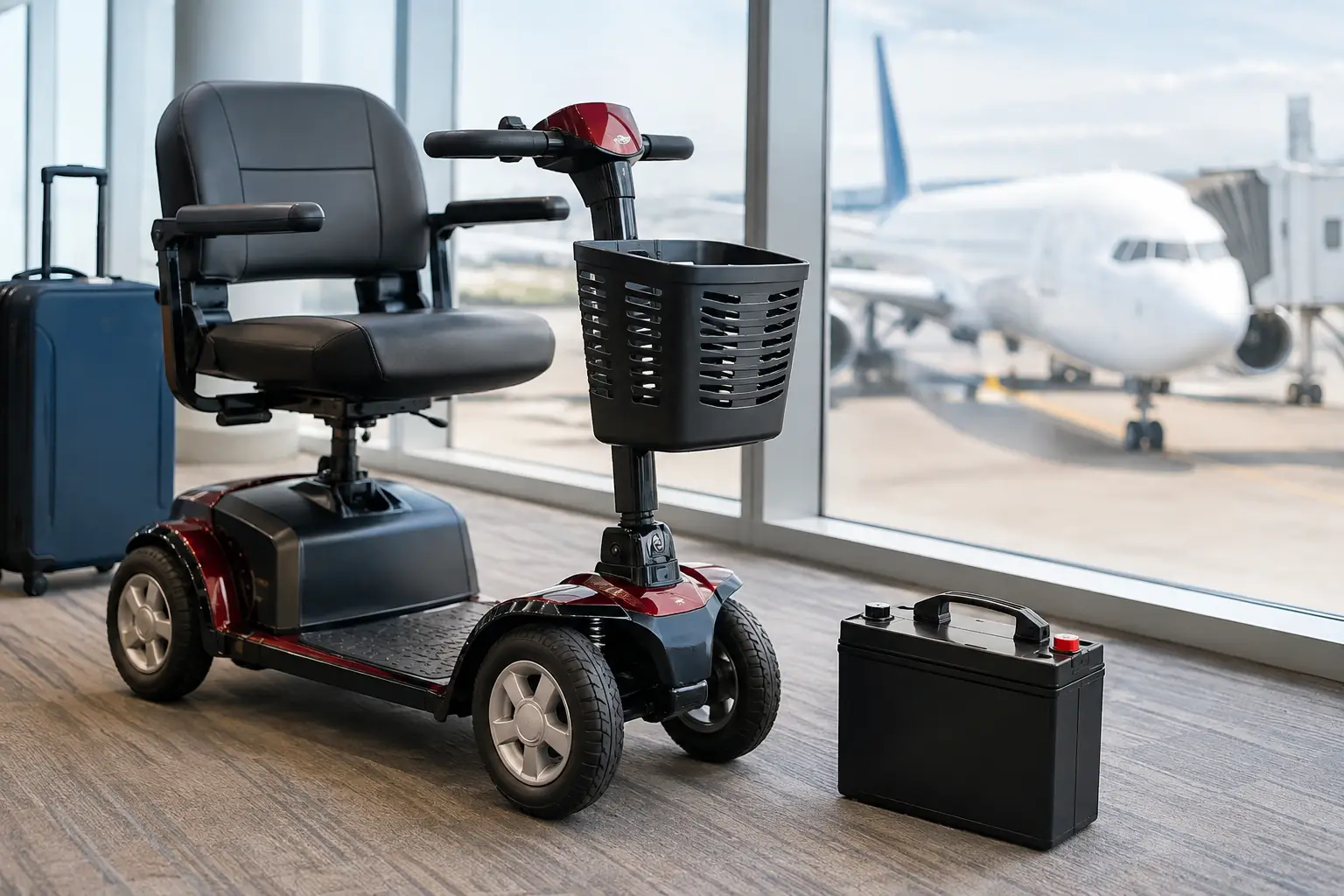
Are Mobility Scooter Batteries Allowed on Planes?
A mobility scooter can make a holiday, family visit or essential journey far more manageable. But before booking, many people ask: are mobility scooter batteries allowed on planes? In most cases, yes. The key point is that airlines assess the battery type, its capacity and how it is fitted to the scooter before they agree to carry it.
A scooter may be accepted as mobility equipment while its battery needs separate handling. Getting this sorted well before departure is the best way to avoid an upsetting surprise at the airport.
Are mobility scooter batteries allowed by airlines?
Most airlines will carry mobility scooters powered by sealed lead-acid, gel, AGM or lithium-ion batteries, provided the equipment meets their safety requirements. However, acceptance is never automatic. Each airline has its own dangerous goods policy, and airport ground staff must follow the approval recorded on your booking.
You should tell the airline that you are travelling with a powered mobility aid when you book, or as early as possible afterwards. Give them the scooter make and model, battery type, voltage, amp-hour rating and, for lithium batteries, the watt-hour (Wh) rating. They may also ask for the scooter’s weight and dimensions so they can confirm it can be safely loaded.
Do not rely on a verbal assurance at check-in. Ask for written confirmation or make sure the approved assistance request appears on your booking. If you are travelling with a package holiday, notify both the travel provider and the operating airline.
The battery type makes a real difference
The label on the battery matters more than whether the scooter is folding, compact or road-capable. If the battery label is missing or unreadable, the airline may refuse to take it, even when the scooter itself is suitable.
Sealed lead-acid, gel and AGM batteries
Many larger pavement and road scooters use sealed lead-acid batteries, often described as non-spillable, gel or AGM batteries. These are commonly accepted for air travel because they are sealed and designed not to leak in normal handling.
The battery will usually remain securely fitted in the scooter. Airport staff may isolate the power, remove the key and protect the controls to prevent accidental operation in the hold. Some airlines ask that the battery terminals are disconnected, so check their instructions rather than making changes at the airport without guidance.
Older flooded or wet-cell batteries need more careful consideration. They may be accepted under stricter conditions, but they are less straightforward to transport and not every airline will carry them. If your scooter uses this type, contact the airline before you book flights where possible.
Lithium-ion batteries
Lithium-ion batteries are popular in lightweight travel scooters because they reduce lifting weight and can make a scooter easier to dismantle or fold for the car. They are also subject to tighter aviation rules.
As a general guide, airlines commonly accept one lithium battery of up to 300Wh, or two batteries of up to 160Wh each, when used for a mobility aid. The battery must normally be removed from the scooter and taken into the cabin, protected from short circuits and damage. A protective case or the manufacturer’s battery cover is often required.
That said, limits and procedures can vary by airline and route. Some airlines require advance approval for every lithium-powered mobility scooter, regardless of capacity. Others may have restrictions on spare batteries, connecting flights or particular aircraft. Always follow the airline’s written instructions over general advice.
If your battery gives its capacity only in volts and amp-hours, the calculation is simple: volts multiplied by amp-hours equals watt-hours. For example, a 24V 10Ah battery is 240Wh. If you are unsure, your scooter supplier or battery manufacturer should be able to help identify the correct rating.
What to do before you travel
Start the process as soon as your travel dates are confirmed, ideally at least a week or two before flying. This leaves time to clarify anything unusual, such as a removable lithium battery or a heavy all-terrain scooter.
Have the following information ready:
- scooter manufacturer, model and overall weight
- battery chemistry, such as AGM, gel or lithium-ion
- battery voltage, amp-hour rating and watt-hour rating where applicable
- whether the battery is removable and how it is secured
- folded or dismantled dimensions, if the airline requests them
Take clear photographs of the battery label and scooter identification label. Keep these on your phone and print a copy for your travel documents. A short handling note can also be useful, particularly if the scooter has a freewheel mode, removable seat, detachable battery box or a specific isolation procedure.
For a lithium battery, carry it in the cabin exactly as instructed by the airline. Protect exposed terminals from contact with coins, keys or other metal objects. Do not place a loose battery in checked luggage unless the airline has explicitly told you to do so.
For a sealed lead-acid battery, do not assume you should remove it. A battery removed unnecessarily can be more difficult to handle safely and may leave staff uncertain how to secure the scooter. Follow the manufacturer’s guidance and the airline’s instructions.
Preparing your scooter for the airport
Airports are busy, and mobility equipment is often handed over at the departure gate rather than the check-in desk. Arrive with plenty of time, particularly on your first flight with the scooter.
Fully charge the battery before leaving home unless the airline says otherwise. A scooter that loses charge during a long terminal walk can create unnecessary stress, and charging points may not be available or suitable. Bring the charger only if you need it during the trip, and pack it safely. Chargers are generally permitted, but they do not replace the need for an approved battery.
Remove personal belongings, shopping bags, cushions that are not fixed in place and any loose accessories. Fold mirrors, lower the tiller where possible and remove the key. If your scooter has a freewheel lever, make sure you understand its position. Ground handlers need to move the scooter safely without accidentally putting it into drive mode.
It is sensible to photograph the scooter from several angles before handing it over. This is not being pessimistic. It simply gives you a clear record of its condition, especially for larger scooters with canopies, baskets or body panels.
A scooter being allowed does not guarantee every journey
Flying is only one part of travel planning. A mobility scooter that is approved by an airline may still be difficult to use at a destination with steep pavements, cobbles, narrow hotel lifts or limited accessible taxi space.
Check whether your accommodation can store and charge the scooter securely. If you use a lithium battery, ask whether you can take it to your room for charging, as some properties have their own fire-safety rules. For larger scooters, confirm that accessible transfers can carry the combined weight of the scooter and any luggage.
Train companies, coaches, cruise operators and local buses can also set their own conditions. Size, weight, turning circle and battery safety all affect whether a scooter can be carried. In the UK, public transport providers often have scooter permit schemes or limits, so it is worth checking before setting out.
When a travel scooter may be the easier choice
A compact travel scooter with a removable, airline-approved battery can make air travel simpler than a heavy pavement model. It may fit more easily in airport vehicles, hotel rooms and accessible taxis. The trade-off is usually a shorter range, lower weight capacity or less suspension for uneven ground.
For some people, the comfort and range of a larger scooter are more important than portability. There is no single right choice. The best option depends on how far you travel each day, whether someone can help with lifting parts, the terrain at your destination and the airline’s battery rules.
At Mobility Scooters UK Ltd, we encourage customers to consider travel plans before choosing a scooter, not after. Battery information, portability and practical handling are as relevant as comfort and range when independence includes holidays and family trips.
A little preparation can protect the freedom your scooter provides. Confirm the battery details early, keep the labels clear and give the airline the information it needs – then you can focus on the journey rather than the check-in desk.