

Powerchair Types: Which One Suits Your Day?
A powerchair should make everyday plans feel possible again, whether that means moving comfortably around the kitchen, visiting family, getting through town or spending more time outdoors. The different powerchair types are designed for very different routines, so the best choice is rarely simply the fastest, smallest or lowest-priced model. It is the chair that suits where you live, how you travel and the support your body needs throughout the day.
For many people, a powerchair offers greater independence than a manual wheelchair, particularly where fatigue, pain, reduced upper-body strength or limited balance makes self-propelling difficult. For relatives and carers, choosing well can also mean less lifting, fewer awkward transfers and more confidence when heading out together.
The main powerchair types explained
Powerchairs are often described by where the drive wheels sit: at the rear, middle or front of the chair. This affects turning, traction and how the chair feels to control. There are also folding and lightweight designs built around storage and transport. Each has a place, but there are trade-offs worth understanding before you buy.
Rear-wheel drive powerchairs
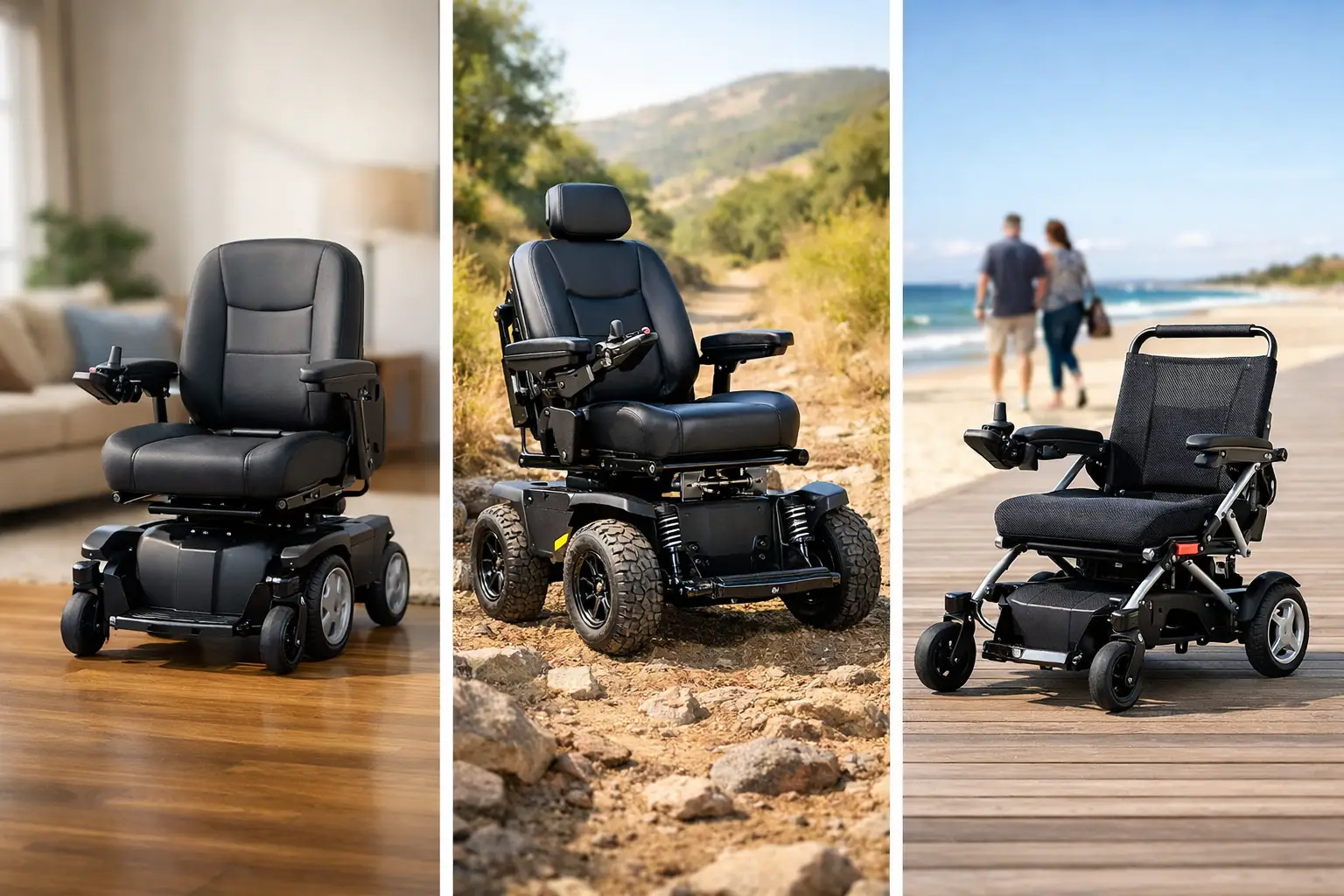
Rear-wheel drive powerchairs are a popular choice for outdoor use. Their larger drive wheels sit behind the user, giving a stable, predictable feel when travelling in a straight line. They can be particularly reassuring on longer paths, dropped kerbs and gently uneven surfaces.
These chairs often offer good suspension, a comfortable ride and useful range for regular trips beyond the home. They tend to suit people who want a dependable chair for shopping areas, local routes and visits where pavements may not be perfectly smooth.
The compromise is turning space. A rear-wheel drive model generally needs more room to turn than a mid-wheel chair, so it may be less convenient in a compact flat, narrow hallway or small bathroom. Measure key spaces at home, including doorways, turning points and the route from the front door to where the chair will be stored.
Mid-wheel drive powerchairs
Mid-wheel drive powerchairs place the main drive wheels directly beneath the seat. This usually gives the tightest turning circle of the main powerchair types, making them especially useful for indoor living. They can turn neatly in kitchens, bedrooms, corridors and accessible shops where space is limited.
Because the chair turns around its centre, users often find its movement intuitive after a little practice. Support wheels at the front and rear help maintain stability, while the central drive wheels provide everyday traction.
A mid-wheel chair can be an excellent all-round option if your day involves plenty of indoor manoeuvring alongside regular pavement use. However, the ride on rough ground may not feel as settled as a larger outdoor rear-wheel model. If your usual route includes gravel, deep grass, steep cambers or poorly maintained paths, look carefully at wheel size, suspension, ground clearance and the manufacturer’s guidance.
Front-wheel drive powerchairs
Front-wheel drive powerchairs have the drive wheels at the front. They are well suited to users who need to approach obstacles closely, as the powered wheels meet a small kerb or threshold before the rest of the chair. They can also provide capable traction on uneven pavement and firmer outdoor ground.
Their shape can make them useful in some tighter spaces, although they may feel different to steer at first because the rear of the chair follows the front wheels through a turn. A short test drive, where possible, is valuable. The right chair should feel controlled and comfortable, not like something you need to wrestle with.
Front-wheel models are often considered by people looking for a practical mix of indoor access and outdoor confidence. As with any larger chair, check its overall length and weight before assuming it will fit in a vehicle or storage area.
Folding and lightweight powerchairs for travelling
Not every user needs a full-size powerchair. Folding powerchairs and lightweight powerchairs are built for people who need to store the chair in a car boot, take it on holidays or keep it out of the way in a smaller home. Many fold manually, while some offer powered folding for added convenience.
Their biggest advantage is portability. A folding chair can make trips with family, appointments and days out much easier where a heavy, non-folding powerchair would be impractical. Some are split into manageable parts, while others fold into one unit.
The key question is not just whether it folds, but whether it can realistically be lifted. Check the heaviest individual part, the height of your car boot lip and who will handle the chair. A chair described as lightweight may still be too heavy for one person to lift safely. Battery type matters too, particularly if you expect to travel by air or need to charge the chair away from home.
Portable models may have smaller wheels, a shorter range and less padding or suspension than larger outdoor chairs. That does not make them a lesser choice. It simply means they are best for users whose priority is convenient transport rather than long, daily journeys over uneven ground.
Choosing a powerchair around your everyday life
Start with the places you use most, not the product description. A chair that is excellent for a large shopping centre may be unsuitable for a narrow terrace house, while a compact folding model may be perfect for car journeys but frustrating on a long rural route.
Think about indoor space first. Measure doorways at their narrowest point, including handles and radiators, and consider the space needed to turn beside a bed, toilet or dining table. Check any thresholds, ramps and slopes too. A small lip can be difficult for some chairs, especially when approached at an angle.
Then consider your outdoor routine. How far do you genuinely expect to travel between charges? Will you mainly use level pavements, or do you regularly face rough surfaces, hills and uneven paths? Battery range figures are useful, but real-world range changes with user weight, terrain, temperature, tyre condition and how often the chair climbs slopes. It is sensible to choose a range with some breathing room rather than planning every journey to the limit.
Comfort deserves the same attention as performance. Seat width and depth, back support, armrests, footplate position and joystick placement all affect whether a chair remains comfortable after an hour or several hours. If you need postural support, pressure relief, a headrest, elevated leg rests or a reclining function, these needs should guide the choice from the start rather than becoming an afterthought.
For some users, a bariatric powerchair may be the safer option. These models are designed with higher user-weight capacities and a roomier, stronger seating base. Always check the stated maximum user weight, and allow for clothing, bags or any equipment carried on the chair.
Transport, storage and legal use in the UK
Before ordering, decide where the chair will live. Larger powerchairs need a dry, secure charging and storage space, ideally with straightforward access so that using the chair never becomes a difficult task in itself. Consider whether it needs to pass through a gate, fit in a shed or be manoeuvred through a communal entrance.
If you plan to use public transport or a wheelchair-accessible vehicle, check the chair’s dimensions and weight with the transport provider or vehicle supplier. Not every powerchair is suitable for every vehicle restraint system. A chair used as a vehicle seat needs the correct approval and securement arrangements – never assume this applies because the chair looks substantial.
For outdoor use, make sure you understand the chair’s speed category and where it can legally be used. Many powerchairs are designed for pavement use, while some Class 3 models can be used on the road where permitted and when registered correctly. The practical point is simple: choose a chair that matches the journeys you actually make, rather than paying for road capability you will never need.
Make the decision with confidence
The best powerchair is one that removes barriers without creating new ones. Rear-wheel, mid-wheel and front-wheel designs each offer real benefits, while folding powerchairs can bring valuable freedom to people who travel by car or have limited storage. A thoughtful choice takes account of comfort, access, terrain, transport and the help available at home.
If you are unsure between two models, write down a typical week: the rooms you move through, the journeys you make, the surfaces you cross and who may need to lift or transport the chair. That simple picture often makes the right direction much clearer, and specialist advice can help turn it into a powerchair you will be happy to use every day.