How to Choose Wheelchair Ramps for Your Home
A ramp that is too short can feel less like a route to independence and more like a steep obstacle. When deciding how to choose wheelchair ramps, the right answer depends on where the ramp will be used, who will use it and whether a wheelchair is being self-propelled, pushed by a carer or powered. A little measuring before you buy can make daily journeys safer, easier and far more comfortable.
Start with the everyday barrier
Begin with the exact obstacle you need to overcome. It may be a single doorstep, a raised threshold, a few garden steps, the entrance to a shop, or access into a car or adapted vehicle. Measure the vertical rise from the ground to the top of the step or threshold. Then consider how much clear, level space is available at both ends of the ramp.
Think about the whole journey rather than the step alone. Is there room to turn a wheelchair before the ramp? Will the user need to stop at a door, perhaps while reaching for a handle? Is the surface at the bottom firm and level, or does it lead straight onto gravel, a slope or a busy pavement? These details affect which style of ramp will feel practical every day.
It also helps to be honest about who will set up and use the ramp. A lightweight folding ramp may suit a family member taking a chair in and out of a car, while a fixed solution may be better for a front entrance used several times a day.
How to choose wheelchair ramps by length and gradient
Ramp length is one of the most important safety considerations. A longer ramp creates a gentler incline, which takes less effort for a wheelchair user and gives a carer more control. A short ramp may appear convenient for storage, but it can be tiring, difficult to manage in wet weather and unsuitable for some powered wheelchairs.
As a broad guide, a 1:12 gradient means one unit of vertical rise for every 12 units of ramp length. For example, a 150 mm rise would need a ramp of at least 1.8 metres at that gradient. Where space allows, a gentler gradient of 1:15 or 1:20 is often more comfortable, particularly for independent manual wheelchair users and those with limited upper-body strength.
The suitable gradient can vary according to the user, wheelchair, surface and setting. Permanent ramps at homes or public buildings may need to meet relevant Building Regulations and accessibility guidance, so professional advice is worthwhile where structural work is planned. For portable ramps, always follow the manufacturer’s stated maximum gradient and use instructions.
Before ordering, record these measurements:
- the height of the step, kerb, threshold or vehicle floor;
- the available length from the obstacle to the point where the ramp can safely rest;
- the width of the wheelchair, including hand rims or any side attachments;
- the width of the doorway, path or vehicle opening;
- the amount of level space at the top and bottom for approaching and leaving the ramp.
Choose the right ramp style for the job
There is no single best wheelchair ramp. The best choice is the one that works reliably in the user’s normal routine.
Threshold ramps for small steps
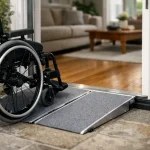
Threshold ramps are designed for low door sills, internal changes in level and small external thresholds. They are often made from rubber, aluminium or durable composite materials. A rubber threshold ramp can be a simple choice for a small lip at a patio door, while a lightweight aluminium option may be more suitable where it needs to be moved or carried.
Check that the ramp sits securely against the threshold and does not prevent a door from opening. For outward-opening doors, the required clearance can easily be overlooked.
Folding and suitcase ramps for flexible access
Folding ramps are popular for doorstep access, visiting family, getting into buildings with a step and loading wheelchairs into vehicles. Many fold in half or in sections, often with a carrying handle, making them easier to store in a hallway, boot or garage.
Portability comes with a trade-off. Longer ramps can be bulky and heavier to lift, even when folded. If a carer will regularly handle the ramp, check its folded weight and dimensions as carefully as its deployed length.
Telescopic channel ramps for vehicle use
Telescopic ramps consist of two separate tracks that extend to the required length. They can be useful for loading a wheelchair or mobility scooter into a vehicle because they take up less storage space than a full-width ramp.
However, channel ramps require careful positioning. The tracks must match the wheel spacing and be secured correctly. They are not usually the easiest choice for someone propelling a manual wheelchair independently, as there is no continuous surface beneath the chair.
Fixed ramps for regular entrances
For a home entrance used every day, a fixed modular ramp can offer the most dependable solution. These systems can include handrails, level platforms and turns where needed, making them suitable for larger changes in height. They require more planning and may involve permissions or property considerations, but they remove the need to lift, unfold and position a portable ramp each time.
Check width, weight capacity and wheelchair type
A ramp must be wide enough for the wheelchair to travel along it without the tyres or hand rims catching the edges. Measure the chair at its widest point, not just the seat width. Powerchairs and bariatric wheelchairs can be considerably wider and heavier than a standard manual chair.
Always check the ramp’s stated safe working load. This should cover the combined weight of the wheelchair, user, accessories and any equipment carried on the chair, such as oxygen, shopping or a bag. Do not assume a ramp suitable for a manual wheelchair will be suitable for a mobility scooter or heavy powerchair.
The way the chair is used matters too. A self-propelled manual wheelchair needs enough space for hands to move along the rims. A carer pushing from behind needs a manageable slope and good footing. For a powered chair, traction, wheel placement and the manufacturer’s advice about slopes should all be considered.
Look for features that improve confidence outdoors
British weather makes grip and drainage especially important. Choose a ramp with a non-slip surface that remains effective in rain, and keep it clear of wet leaves, moss, ice and loose mud. Raised edges can help prevent wheels from slipping off the side, while secure top lips, locating pins or fixing points help stop the ramp moving during use.
For longer ramps, handrails and resting platforms can make a major difference. A level landing is particularly useful outside a doorway, as it gives the user space to pause and open the door without balancing on an incline.
Avoid improvising with loose boards, makeshift wedges or ramps that do not sit flat. Even a small movement under a wheelchair can be unsettling and potentially dangerous. If the ground is uneven, a ramp may need a different position, a level base or a more permanent installation.
Consider storage, transport and daily handling
A ramp only supports independence if it can be managed in real life. If it will travel in a car, measure the boot opening and available storage space first. If it will be kept indoors, consider whether it can be folded and moved without blocking a hallway or creating a trip hazard.
Some customers need a ramp for occasional days out, while others need one at the front door every morning and evening. For occasional use, a compact folding design may offer good value. For repeated access at home, spending more on a longer, sturdier or fixed ramp can be the more comfortable and dependable choice over time.
At Mobility Scooters UK Ltd, practical advice starts with the same questions: what needs to be cleared, what wheelchair is being used and how will the ramp fit into everyday life. Taking those measurements and considering the user’s confidence will help you choose a ramp that supports safer movement without making each journey feel like a challenge.
The right ramp should fade into the background of the day – simply making the front door, car, garden or favourite local outing feel within reach again.