How Far Can Mobility Scooters Travel? UK Range
A scooter’s stated range can look reassuring on a product page, but the number that matters is the one that fits your real routine: getting to the shops and back, visiting friends, travelling around a holiday park or enjoying the park without watching the battery gauge. So, how far can mobility scooters travel? Most models offer anything from around 6 to 35 miles on one charge, while some larger road-capable scooters can travel further in ideal conditions.
The right range is not necessarily the highest range. A compact scooter with an 8-mile range may be an excellent choice for short local trips and car journeys. For regular pavement journeys, uneven ground or longer days out, a larger battery and a more comfortable scooter may offer greater confidence and freedom.
How far can mobility scooters travel on one charge?
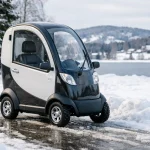
As a broad guide, travel and folding mobility scooters often provide around 6 to 15 miles per charge. These models are designed to be lighter, simpler to transport and easier to store, so their batteries are usually smaller than those fitted to larger scooters.
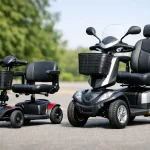
Mid-sized pavement scooters commonly offer a range of about 15 to 25 miles. This can suit someone who wants to visit local shops, appointments, neighbours and parks without charging after every outing. They often balance a practical everyday range with a comfortable seat, better suspension and useful storage.
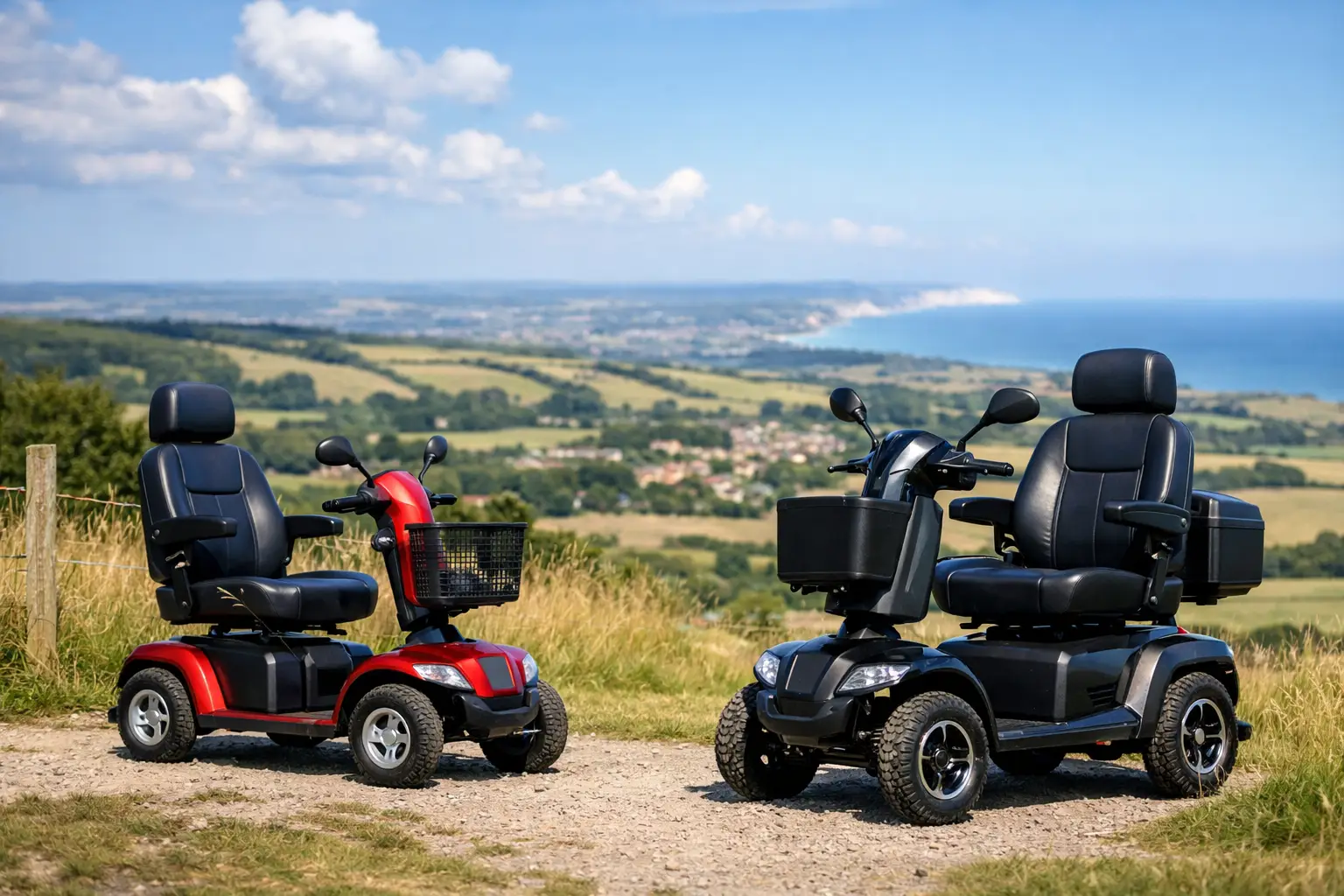
Larger Class 3 and road-capable mobility scooters may achieve 20 to 35 miles or more, depending on the model and battery configuration. They are built for longer journeys and can be a sensible option for users who travel further from home, particularly where local routes include roads, longer pavements or rougher surfaces.
These figures are manufacturer estimates, generally measured under favourable test conditions. Think of them as a useful comparison point rather than a promise that every journey will deliver the same mileage.
Why real-world range can be lower
Battery range changes with the way a scooter is used. A smooth, flat pavement on a mild day requires far less power than a steep hill, loose gravel or wet grass. Carrying shopping, travelling at higher speeds and frequent stopping and starting can also reduce the distance available.
User weight matters too. Every scooter has a maximum user weight, and remaining comfortably within it helps the motor and battery work as intended. This is particularly worth considering if you regularly carry bags, oxygen equipment or other essentials in a basket or storage compartment.
Cold weather can temporarily reduce battery performance. In the UK, this is most noticeable during winter, when batteries may not hold or deliver power as efficiently. Battery age is another factor. Like any rechargeable battery, scooter batteries gradually lose capacity over time, even with good care.
Terrain makes a substantial difference. A small car-boot scooter may manage a level shopping centre very well but use more power on sloping pavements, dropped kerbs and country paths. If your usual journey includes hills, speak to a specialist before choosing based on range alone. Motor power, ground clearance, tyre type, suspension and the scooter’s overall stability are just as relevant.
Choose a range that leaves a sensible margin
It is best not to buy a scooter with a quoted range that exactly matches your longest expected round trip. If your regular journey is six miles there and back, a model advertised with a 6-mile range leaves no allowance for hills, diversions, colder weather or a battery that is no longer brand new.
A sensible rule is to choose a scooter with comfortably more range than you expect to use on a normal day. For example, an advertised range of 12 to 15 miles may be more suitable for a regular 6-mile outing. This avoids the worry of getting home with a very low battery and gives you the option of making an unplanned stop.
For some people, portability is the priority. If the scooter must fit in the boot of a small car, be dismantled for family outings or be stored in a hallway, a compact model may be the right choice even if it has a shorter range. For others, being able to make independent trips around their community without relying on a lift is more valuable than easy lifting. There is no single best answer – only the best fit for your everyday life.
Range by scooter type
Folding and car-boot scooters
These are ideal for shorter distances and journeys where transport matters most. Many can be folded or separated into manageable sections, making them a practical companion for shopping trips, visiting family or taking on holiday. Their smaller size usually means a shorter battery range, so they are best for local use rather than frequent all-day travel.
Pavement scooters
A pavement scooter can offer a useful step up in comfort and range. It is often a good choice for people who need more support than a lightweight travel model can provide but do not require a large road scooter. Features such as a padded swivel seat, larger wheels and a basket can make ordinary errands far more comfortable.
Road-capable and all-terrain scooters
Larger scooters are designed for users who need longer range, greater stability and a more confident ride outdoors. They can be especially suitable for rural areas, longer routes and uneven paths, provided the model is appropriate for the intended use. Their size and weight mean they need suitable storage and may not fit into a car boot, so planning where the scooter will live and charge is essential.
Getting the most from every charge
Good charging habits protect both your range and your battery investment. Charge the scooter after use, particularly if the battery gauge has dropped significantly, and use the charger supplied or approved for that model. Leaving a battery partly discharged for long periods can shorten its working life.
If you do not use the scooter every day, follow the manufacturer’s guidance on maintenance charging. This is particularly helpful over winter or when recovering from illness, when a scooter may be parked up for several weeks. Keep batteries and the scooter in a dry, secure place away from extreme cold where possible.
Before a longer trip, check the battery indicator, tyres and general condition of the scooter. Soft tyres can increase resistance and reduce efficiency, while worn batteries may show a full charge but run down more quickly than expected. If range has noticeably fallen, a battery check can help establish whether replacement batteries or a service are needed.
Avoid making battery range a test of nerve. If you are going somewhere unfamiliar, take the charger where practical, identify places to rest and charge if available, and allow extra distance for detours. This is particularly useful on day trips, at large attractions and when using a scooter around a holiday destination.
Questions to ask before you buy
Start with your normal journeys rather than the specification sheet. How far is the local pharmacy, supermarket, post office or bus stop? Are there hills on the way? Will you use the scooter only on dry pavements, or also on park paths and uneven ground? Will it need to go into a car?
Then consider comfort. A longer stated range is less useful if the seat, leg room or suspension makes the journey tiring. Likewise, a compact scooter is not a bargain if it is too heavy for the person who needs to lift it. Looking at range alongside seat comfort, weight capacity, portability, storage and local terrain leads to a safer choice.
Mobility Scooters UK Ltd can help buyers and carers compare recognised brands and scooter styles in plain English, so the decision is based on daily needs rather than headline figures alone.
The best mobility scooter range is the one that lets you make your usual journeys with battery to spare, comfort throughout and the reassurance that home is never just beyond reach.