Wheelchair Ramps for Door Thresholds at Home
A doorstep lip of only a few centimetres can stop a wheelchair completely, catch small front castors or make every exit feel like a struggle. The right wheelchair ramps for door thresholds turn that awkward bump into a manageable, safer route between rooms, through a front door or out to the garden.
For many households, a threshold ramp is one of the simplest changes that can make a real difference to daily independence. It can reduce the need for lifting, make it easier for a family member to help, and allow a wheelchair, powerchair or mobility scooter to pass through a doorway more smoothly. The key is choosing a ramp that suits the threshold, the equipment and the person using it.
Why door thresholds need more than a quick fix
Door thresholds are designed to keep out rain, draughts and dirt, but they can create an avoidable barrier. Older properties often have raised stone, timber or metal sills. Patio and conservatory doors may have tracks that are difficult for narrow wheelchair castors. Front doors can have a step down on the outside as well as a raised edge inside.
Placing a loose piece of timber over the obstacle might seem like a low-cost answer, but it can slip, split, create a steeper edge or become unsafe in wet weather. A purpose-made threshold ramp has a stable shape, a gradual incline and a surface intended to provide grip. It is a practical investment in safer movement around the home.
Not every threshold needs the same solution. A 15 mm internal lip needs a very different ramp from a 75 mm external uPVC doorway with a sloping approach. Before buying, look at the full route rather than just the highest point.
Measuring wheelchair ramps for door thresholds
Accurate measurements prevent the most common ordering mistakes. Use a tape measure and record the height from the floor or ground up to the top of the threshold. Then measure the clear width of the doorway, including the narrowest point when the door is fully open.
Also check the available space on both sides. A ramp may fit the doorway width but extend too far into a hallway, block a door from opening, or land on uneven paving outside. If there is a drop on the far side, measure that too. Some thresholds need a ramp on one side, while others need a bridge-style ramp that rises over the centre and slopes down on both sides.
The wheelchair or scooter matters just as much as the doorway. Check the overall width, the width between wheels where relevant, ground clearance and the size of the front castors. Small castors are more likely to snag on abrupt edges. A larger powerchair or mobility scooter may need a wider, stronger ramp and a longer gradient than a lightweight manual wheelchair.
For a ramp used by more than one person, base the decision on the heaviest item likely to cross it. That includes the user, wheelchair or scooter, shopping bags, oxygen equipment and anything else normally carried.
Think about gradient, not only height
A short ramp can look neat, but a steep slope may be hard to propel up independently and uncomfortable to descend. A longer ramp generally gives a gentler, more confidence-inspiring approach. This is particularly useful for people with limited upper-body strength, carers assisting from behind, or outdoor doorways that may become damp.
Space sometimes limits how long a ramp can be. In that case, it may be better to consider a different ramp profile, alter the approach area or ask for specialist advice rather than forcing a steep model into a tight gap.
Choosing the right threshold ramp type
Threshold ramps are available in several styles, each designed around a particular doorway and daily routine. The best choice depends on whether the ramp is permanent or temporary, indoors or outdoors, and used by a manual chair, powerchair or scooter.
Rubber threshold ramps
Rubber ramps are a popular choice for small to medium-height thresholds. They are usually weighty enough to sit securely in place without fixings, can be trimmed in some cases to suit the opening, and provide a firm non-slip surface. Their solid construction makes them well suited to frequent indoor use, such as moving between a hall and kitchen, or from a living room into a conservatory.
They also cope well with occasional outdoor use, although drainage and the condition of the surface underneath should be considered. Rubber ramps are less convenient if you need to carry the ramp in a car or move it regularly, as they can be heavy.
Aluminium threshold ramps
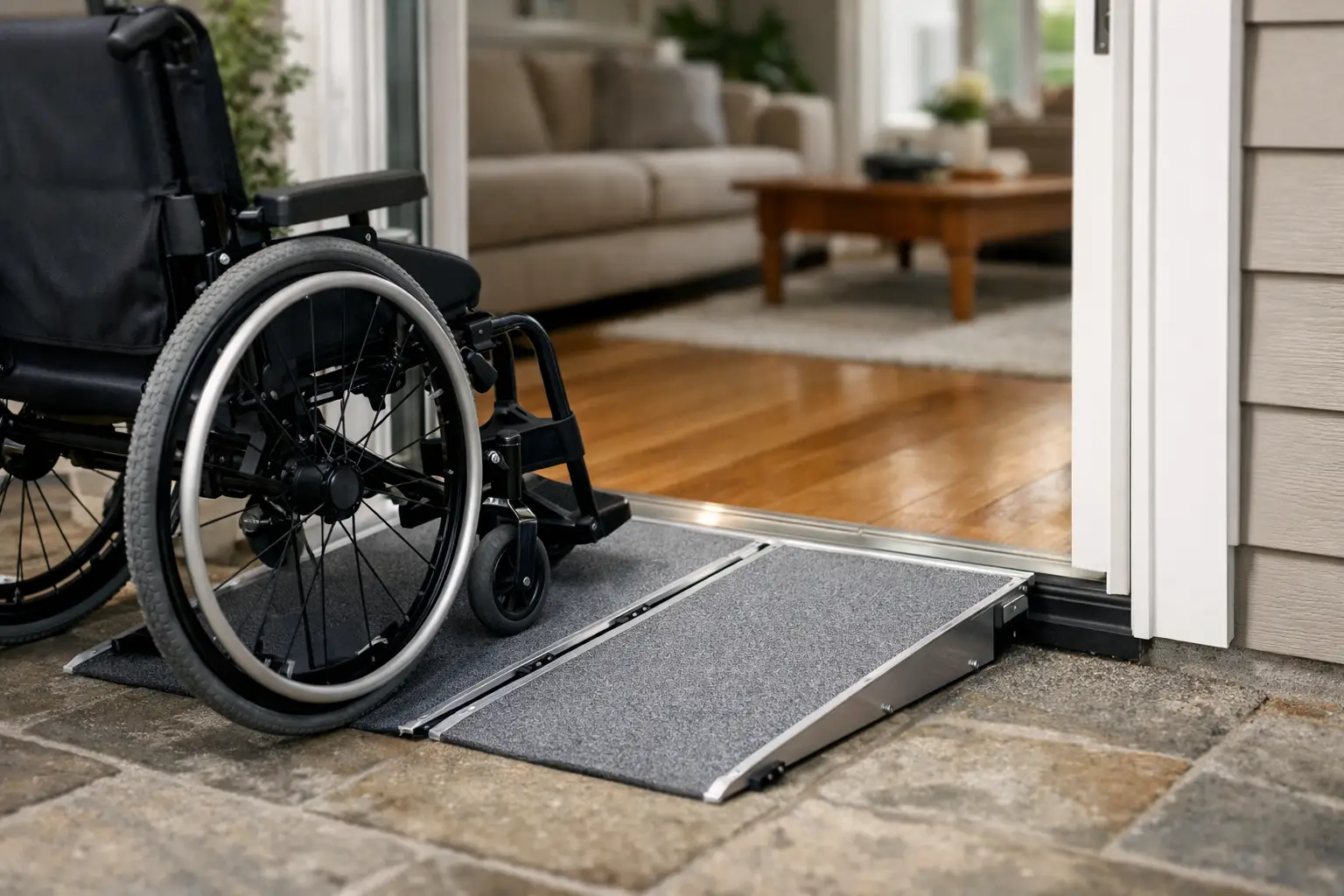
Aluminium ramps are light, durable and often easier to move into position. Many feature a grip surface and raised edges to help guide wheels. They are useful for front doors, patio doors and situations where the ramp needs to be lifted away when not in use.
Some aluminium models are designed as narrow channels or folding sections, while others provide a full-width platform. A full-width ramp is usually the more comfortable option for wheelchairs and powerchairs because it offers a continuous surface. Channel ramps can work well in specific circumstances, but wheel spacing must match precisely and they are not generally suitable for every mobility scooter.
Bridging ramps for raised sills and tracks
A bridging threshold ramp is made to cross an obstacle with slopes on either side. This can be particularly helpful for sliding patio door tracks, uneven door sills or thresholds where there is a drop inside and outside. It should sit securely without rocking and allow the door to operate freely.
For external doors, check that rainwater can still drain as intended. Blocking drainage channels may lead to water pooling near the doorway, so it is worth taking a careful look before fitting anything permanently.
Safety checks before using a threshold ramp
A suitable ramp should feel secure, level and predictable under the wheels. Before relying on it alone, test it carefully with support nearby. Check that it does not move when a wheelchair approaches, that wheels do not catch at the top edge, and that the user has enough room to turn or stop safely after crossing.
Keep the ramp clean. Mud, wet leaves, frost and loose grit can reduce grip outdoors. Indoors, check for curled mats or carpet edges around the ramp. If a ramp begins to shift, crack, bend or lose its non-slip surface, stop using it until the problem is resolved.
Pay close attention to weight capacity. Manufacturers state a maximum load for a reason, and exceeding it can damage the ramp or make it unstable. The figure needs to cover the combined weight of the wheelchair or scooter, user and belongings – not simply the chair on its own.
Doors also deserve a check. A ramp must not prevent a front door from opening fully, catch on an automatic closer or create a trip hazard for others in the household. If the doorway is used in an emergency escape route, make sure the setup remains easy for everyone to use.
Permanent fitting or a portable solution?
A fixed threshold ramp can be reassuring where the same doorway is crossed many times a day. It provides a consistent route and avoids the need for anyone to position equipment before going out. This may suit a main entrance, a garden door or an internal doorway used by a wheelchair user every day.
A portable ramp is often more practical for rented homes, visiting relatives, holidays or occasional access needs. It can also be useful when a household is still working out the most comfortable layout. The trade-off is that someone must store, carry and position it correctly each time.
If you rent your home, speak to the landlord or housing provider before making permanent alterations. For a larger entrance step, uneven path or significant level change, a threshold ramp alone may not be enough. A longer access ramp, handrails or an assessment of the wider entrance may be needed for a safe result.
A better route should feel ordinary
The best threshold ramp does not make a home feel clinical or complicated. It simply removes a frustrating barrier, so getting to the kitchen, answering the front door or enjoying fresh air in the garden takes less effort. If measurements, gradients or wheelchair compatibility are unclear, asking a mobility specialist before ordering can provide the reassurance needed to choose a ramp that supports everyday freedom from the first use.