Choosing a Folding Mobility Scooter for Travel
A folding mobility scooter for travel can make the difference between planning a day around walking distances and simply getting on with it. Whether you are visiting family, taking a coach trip, going shopping in another town or heading away for a holiday, the right scooter should be easy to handle without asking you or a carer to compromise on comfort and safety.
Travel scooters are not all the same. Some fold at the touch of a button, while others are designed to be taken apart into smaller sections. Some are light enough for one confident person to lift, while others still need two people or a ramp. Looking beyond the word ‘folding’ helps you choose a scooter that genuinely suits the journeys you make.
Start with the journey you make most often
Think first about how the scooter will get from home to where you want to go. If it will usually travel in the boot of a hatchback, estate car or taxi, check the folded dimensions as well as the total weight. A compact-looking scooter can still be awkward to lift if its heaviest part is beyond what you, a partner or carer can safely manage.
For train and coach journeys, a small folded footprint is helpful, but it is only part of the picture. You will also need to consider whether staff can safely accommodate the scooter, the space available on board and how far you will travel after arriving. It is sensible to contact the transport provider before booking, particularly for longer-distance travel or international journeys.
A scooter for occasional holidays may need different features from one used every day. A very lightweight folding model can be ideal for airport transfers, hotel corridors and short sightseeing trips. If you expect to use it daily around your local area too, you may prefer slightly more range, a more supportive seat and larger wheels, even if that means a little more weight.
Folding mobility scooter for travel: folding or dismantling?
The phrase ‘folding scooter’ is often used for several types of portable scooter, so it is worth understanding the difference before you buy.
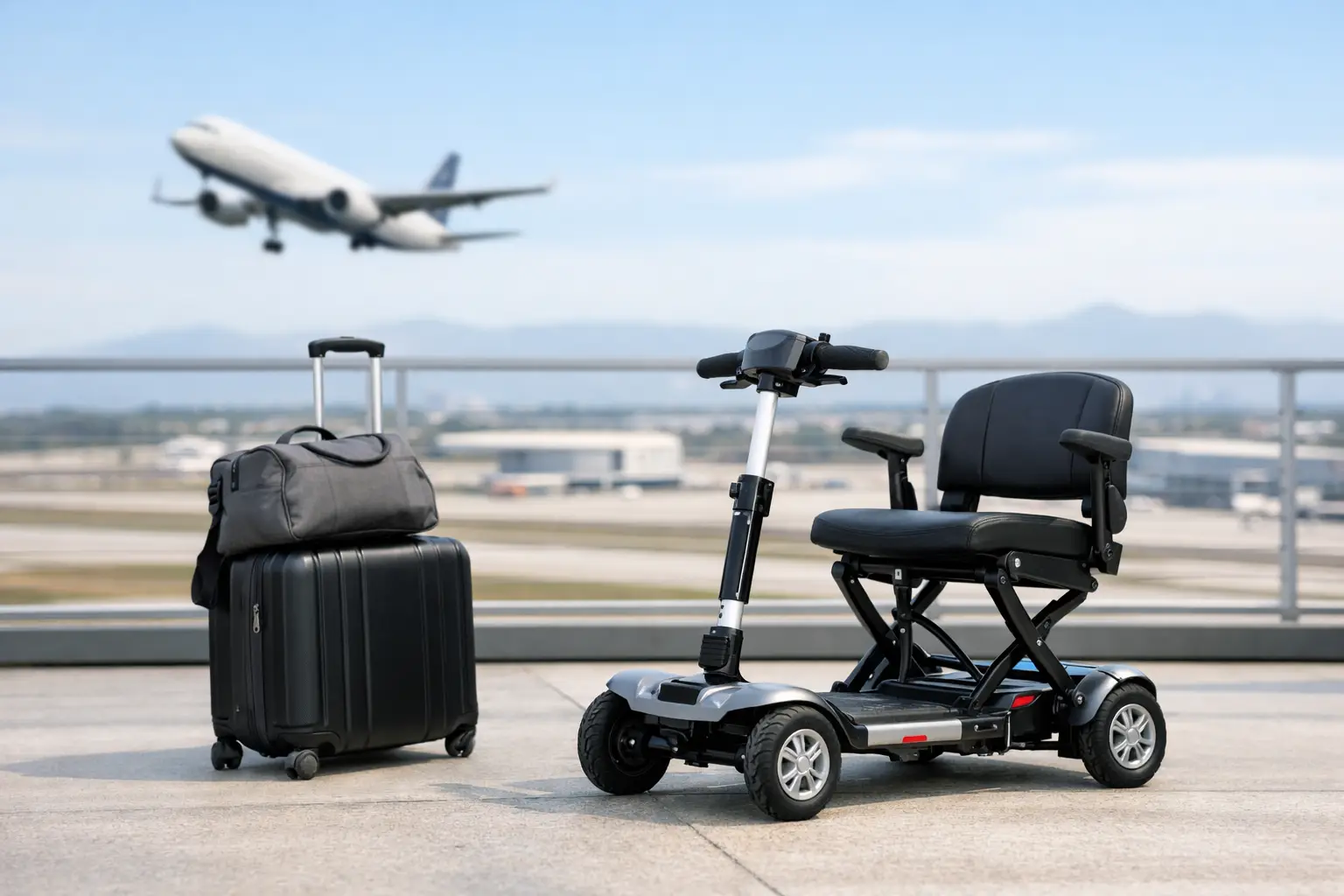
A true folding model collapses into one unit. Manual versions may require you to release a catch and fold the frame, while automatic versions use a remote control or button. This can be especially useful if bending, grip strength or hand dexterity are a concern. Once folded, it can often be wheeled like a small suitcase, although it still needs to be lifted into a car.
A dismantling travel scooter separates into several manageable pieces, commonly including the seat, battery, rear motor section and front frame. It may take a little longer to assemble, but the heaviest individual component can be considerably lighter than a one-piece folding scooter. For many customers, this is the more realistic option when regular car transport is essential.
Neither design is automatically better. Automatic folding is convenient for someone travelling alone or with limited hand strength. A dismantling scooter may be more practical where a carer needs to lift it into a small boot. The best choice is the one you can manage safely every time, not just on a good day.
Weight matters, but so does where you hold it
It is easy to focus on the advertised overall weight, but lifting comfort depends on more than a number. Consider the weight of the heaviest liftable section, whether there are useful handles, the height of your car boot lip and how far you need to reach in to place the scooter.
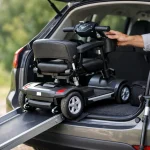
Try to avoid lifting from a twisted position. If a scooter needs to be lifted high over a boot sill or moved across a deep boot floor, even a lighter model can become difficult. A portable ramp or vehicle hoist may be worth considering where lifting is a regular challenge. This can make a more comfortable scooter possible without putting strain on the person doing the lifting.
Also check the user weight limit. It should comfortably accommodate the rider and any regular belongings, such as a handbag, walking stick or small shopping bag. Choosing a scooter close to its maximum capacity is rarely the most reassuring option, especially when it will be used on slopes or uneven pavements.
Battery range and air travel need careful planning
Published range figures are useful for comparison, but they are usually based on favourable conditions. Hills, cold weather, rough surfaces, tyre pressure, rider weight and frequent stopping can all reduce the distance you achieve. For local days out, leave a healthy margin rather than planning to return home with the battery almost empty.
Most modern folding travel scooters use sealed batteries, often lithium batteries. They are light and convenient, but airlines have their own rules on battery type, capacity, removal and carriage. Do not assume that a scooter accepted by one airline will be accepted by another.
Before flying, contact the airline well in advance and ask for its current policy in writing if possible. Confirm the battery specification, whether it must be removed, how it should be protected and whether approval is needed before travel. Keep the scooter’s battery information with your booking documents. Airport assistance should also be arranged early, as it can make the journey through check-in and security far less tiring.
If flying feels like too much administration, a folding scooter is still excellent for UK breaks. Cars, accessible taxis, rail journeys and cruises can all become more manageable when your mobility equipment is compact and familiar.
Comfort is not an extra
A travel scooter may be small, but it should not leave you feeling unsteady or sore after half an hour. Look at the seat width, back support, armrests and legroom. If you have hip, knee or back pain, the way you get on and off is just as important as how the scooter feels once you are seated.
Smaller wheels and a shorter wheelbase make a scooter easier to manoeuvre in shops, cafés and hotel rooms. The trade-off is that it may feel less settled over dropped kerbs, cobbles and uneven paths. Suspension is not common on the lightest folding models, so be realistic about the surfaces you will encounter.
For a mainly indoor or paved-route user, a compact model may be exactly right. For rural lanes, rough parks or steep ground, a larger pavement or all-terrain scooter could offer more confidence, although it will not be as easy to transport. There is no benefit in buying the smallest option if it prevents you from using the places that matter to you.
Check the practical details before ordering
A few measurements can prevent an expensive mismatch. Measure your car boot opening, internal boot depth and height under the parcel shelf. Measure your narrowest doorway at home too, including any tight turns in a hallway. Compare these with both the folded and opened dimensions of the scooter.
It is also sensible to check its ground clearance, turning circle, maximum gradient and charging arrangement. Can the scooter be charged where it is stored? Will the charging point be easy to reach? If the battery is removable, can you carry it indoors comfortably?
A travel scooter should have clear, simple controls and a speed setting that feels manageable. If you are a first-time user, allow time to practise in a quiet, level area before a busy outing. Learn how to fold or dismantle it, engage freewheel mode and secure it for transport. A carer should practise too if they will be helping regularly.
Make travelling less dependent on other people
The purpose of a portable scooter is not to make every journey perfect. It is to give you more choices: staying out for lunch without worrying about the walk back, joining family days out, visiting places that would otherwise feel out of reach, or managing a holiday with less fatigue.
Mobility Scooters UK Ltd can help customers compare recognised brands and practical features, from compact automatic folding models to car-boot scooters with lighter separate parts. Specialist advice is particularly valuable if you are balancing comfort, lifting ability and transport needs for the first time.
A folding scooter is a worthwhile investment when it fits your real routine, not an imagined one. Choose for the journey you take most often, leave room for your comfort and ask for support where lifting, batteries or transport arrangements are uncertain. That careful choice can make the next trip feel far more like your own.